Ai Weiwei, The Witness
The Witness by Josef O’Connor
9 July, 2026
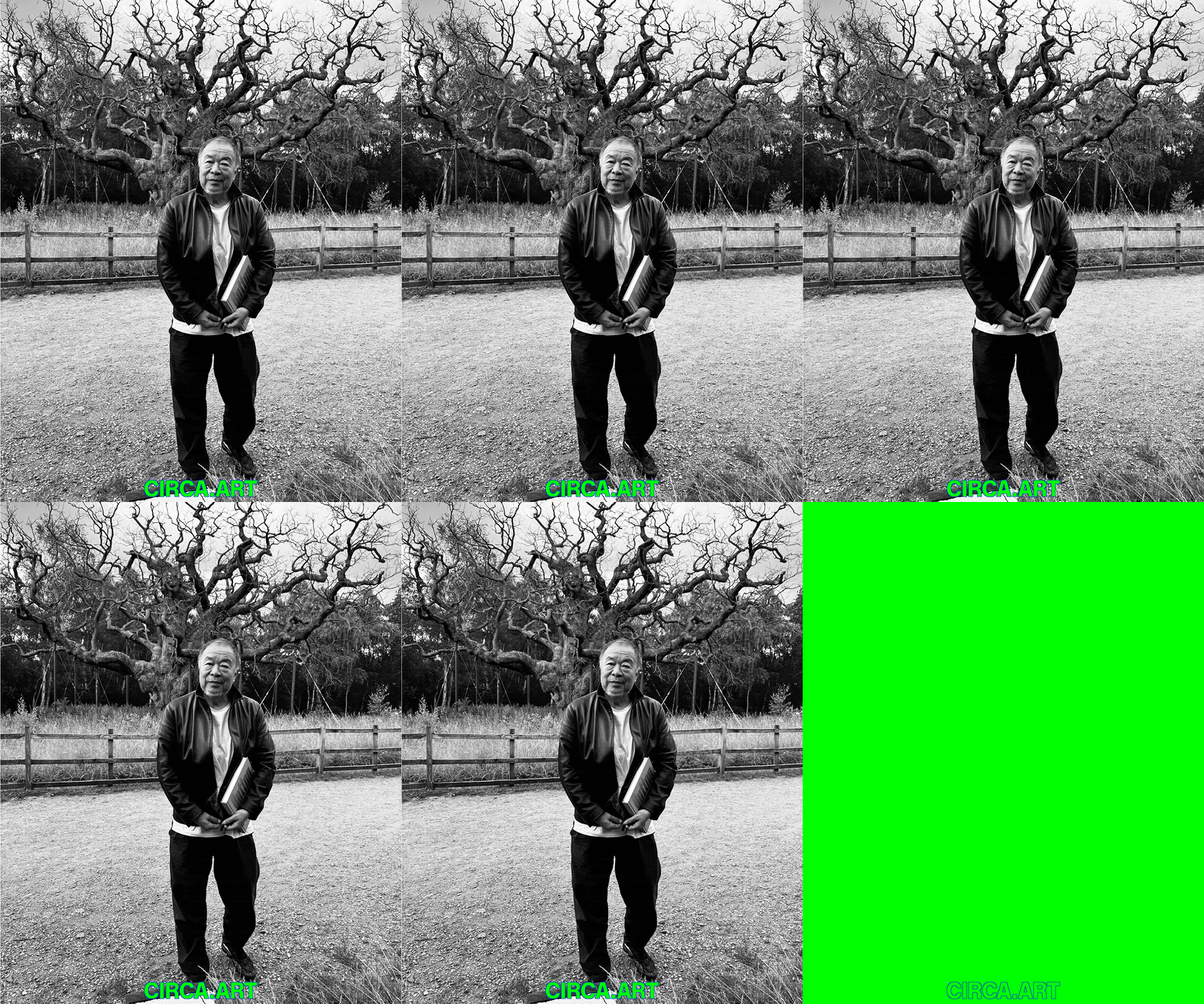
A few days before the Summer Solstice, I woke up to a series of screenshots from Ai Weiwei. The messages concerned the Major Oak in Sherwood Forest, a tree believed to be approximately 1,200 years old which had just been declared dead by the Royal Society for the Protection of Birds. There was no accompanying explanation and no direct request. After working with Weiwei for the better part of 5 years, I understood immediately what was being asked of me. The tree had captured his attention and he wanted to see it. Two days later, after a hastily arranged visit, we were standing beneath its branches on the longest day of the year.
The Major Oak occupies a singular place within the British imagination. Long associated with the mythology of Robin Hood, although considerably older than the legend itself, the tree was already ancient when the Norman Conquest began. It has survived the rise and fall of kingdoms, religious reformations, plague, civil war, industrialisation and two world wars. During those twelve centuries, countless generations have passed beneath its canopy. The tree witnessed history not as a sequence of events recorded in books, but as lived experience unfolding around it. Standing before it, one becomes aware that its death represents more than the loss of a biological organism but the disappearance of a witness.
In the days leading up to the opening of Button Up! at Factory International, I found myself returning repeatedly to a similar idea. Although the exhibition initially presents itself through an extraordinary range of forms, materials and scales, a common thread gradually emerges. Everywhere there are objects that have somehow survived the worlds that produced them. The vast Wang Family Ancestral Hall, originally constructed during the late Ming Dynasty in Jiangxi Province, confronts visitors immediately upon entering the galleries. Built approximately 400 years ago as a communal space for gathering, worship and civic discussion, much of the structure was destroyed during the Cultural Revolution before the surviving section was acquired by Weiwei, dismantled and painstakingly reconstructed. What remains today is not simply an architectural achievement but a fragment of another world, carrying within it traces of social systems, beliefs and forms of craftsmanship that have largely disappeared.

The same principle can be observed elsewhere throughout the exhibition. A visitor moves from the ancestral hall towards History of Bombs, Weiwei’s monumental series depicting nuclear weapons and ballistic missiles through thousands of individual Lego bricks. Nearby are works addressing migration, conflict, mortality and political power. There are skulls, refugee vessels and fragments of material culture shaped by both violence and survival. What unites these works is not simply a preoccupation with history, but an interest in what history leaves behind. They are all, in different ways, witnesses.
This idea has appeared throughout Weiwei’s practice for decades. Following the 2008 Sichuan earthquake, he collected tonnes of twisted steel reinforcement bars recovered from collapsed school buildings and transformed them into Straight, one of the defining works of his career. The steel functions simultaneously as sculpture, memorial and evidence, preserving the physical traces of an event that authorities sought to obscure. Again and again, Weiwei returns to objects that carry history within them. His work is rarely about the creation of symbols. More often, it involves revealing the stories already embedded within things.
Driving to Sherwood Forest, our conversation drifted towards the exhibition and the number of works that seemed to touch upon mortality in one form or another. At one point, Weiwei simply shrugged and said, “I like making work about death.” Yet standing beneath the Major Oak later that afternoon, I began to suspect that death alone does not adequately explain what is taking place within the exhibition. Again and again, the works return not only to what disappears, but to what survives. This distinction becomes particularly interesting when considering the relationship between Wang Family Ancestral Hall and History of Bombs. Confronting each other from opposite ends of the gallery, the works stand 400 years apart embodies the achievements of traditional craftsmanship, the other the technological capabilities of the modern military-industrial complex. Yet viewed together, they suggest a surprisingly hopeful proposition. The knowledge required to construct the ancestral hall once represented a sophisticated and widely understood form of expertise. Today many of those techniques have disappeared or survive only in fragments. Looking at the bombs, missiles and nuclear weapons constructed from thousands of Lego pieces, one begins to wonder whether Weiwei is inviting us to imagine a similar fate for these technologies. Perhaps the deepest optimism embedded within the work is the possibility that future generations might regard nuclear weapons as we now regard the vanished systems of craftsmanship embodied by the ancestral hall: relics of another age rather than forces shaping the present.
The idea of continuity in the face of historical upheaval also runs through the work of Weiwei’s father, the poet Ai Qing. In 1940, during the Second Sino-Japanese War, he wrote his celebrated poem Trees, a meditation on solidarity and shared humanity during a period of conflict, imagining individual trees standing apart while their roots remain invisibly connected beneath the earth:
One tree, another tree,
each standing alone and erect.
The wind and air
tell their distance apart.
But beneath the cover of earth
their roots reach out,
and at depths that cannot be seen
the roots of the trees intertwine.
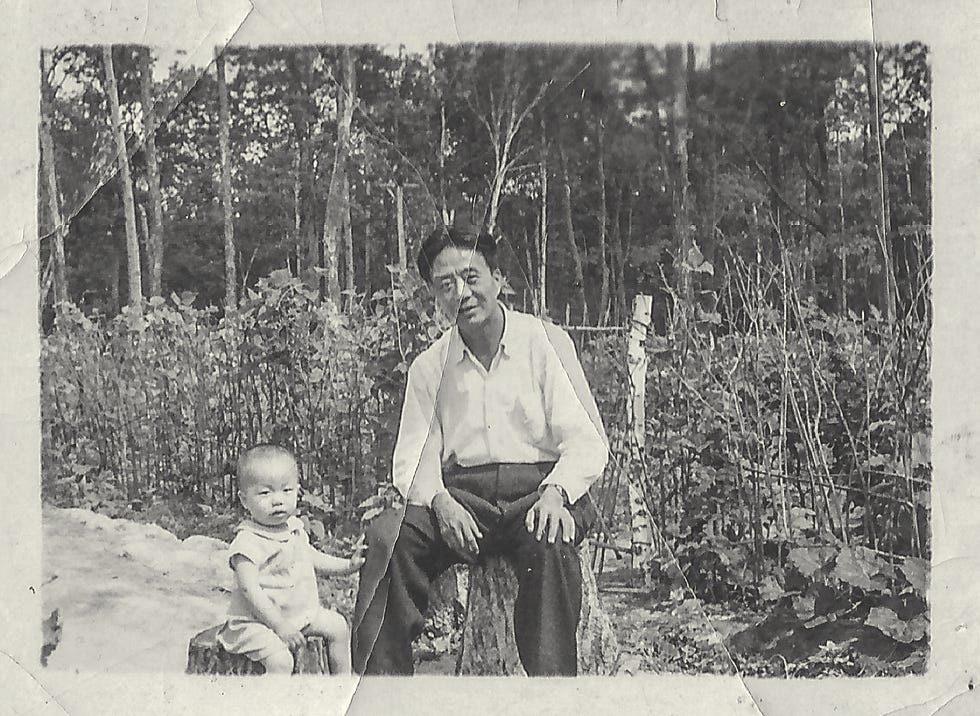
Reading the poem today, it is difficult not to recognise its relevance to the concerns animating Sewing a Button. Throughout the exhibition, objects separated by centuries, continents and political systems appear to exist in conversation with one another. A Ming Dynasty ancestral hall, industrial buttons salvaged from a British factory, images of nuclear weapons, refugee vessels and a dying oak tree in the English countryside all seem unrelated until one begins to trace the invisible roots connecting them.
The buttons themselves emerged from one such connection. Long before they became artistic material, they occupied a deeply personal place in Weiwei’s life through childhood memories of scarcity, family history and later imprisonment. Their transformation into the monumental flags presented in Manchester demonstrates a recurring characteristic of his practice. Like so many objects in the exhibition, the buttons become witnesses to something larger than themselves.
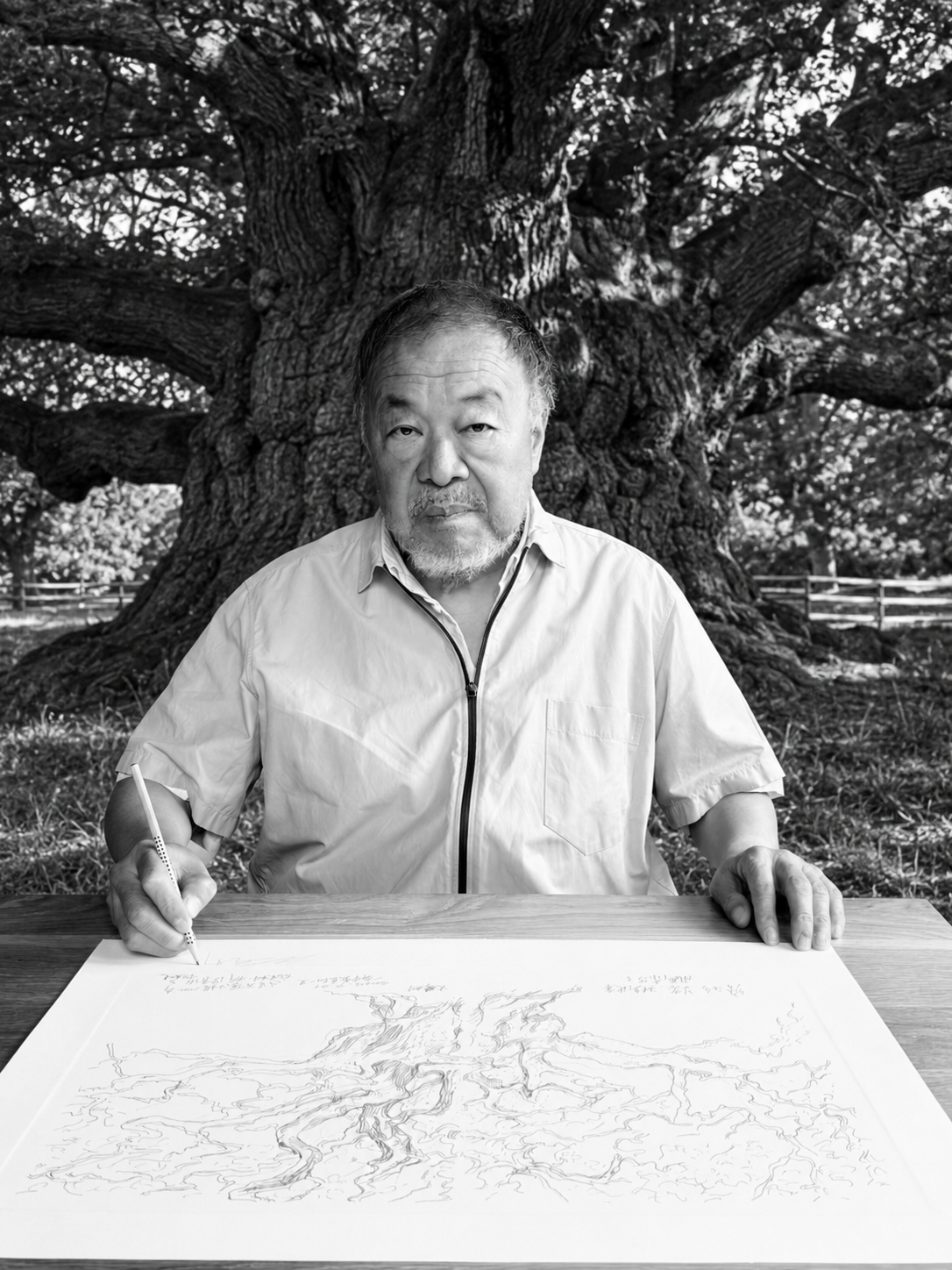
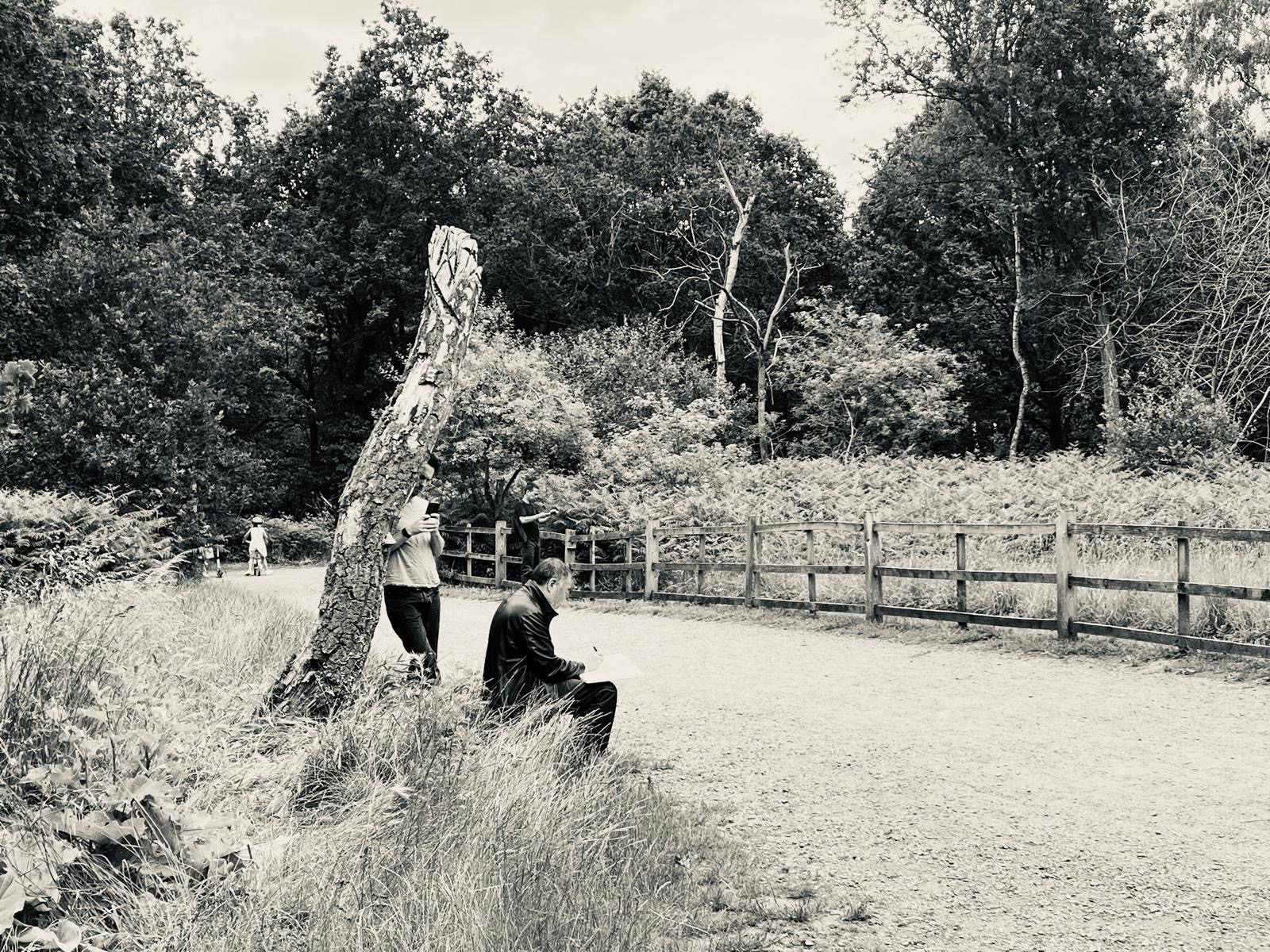
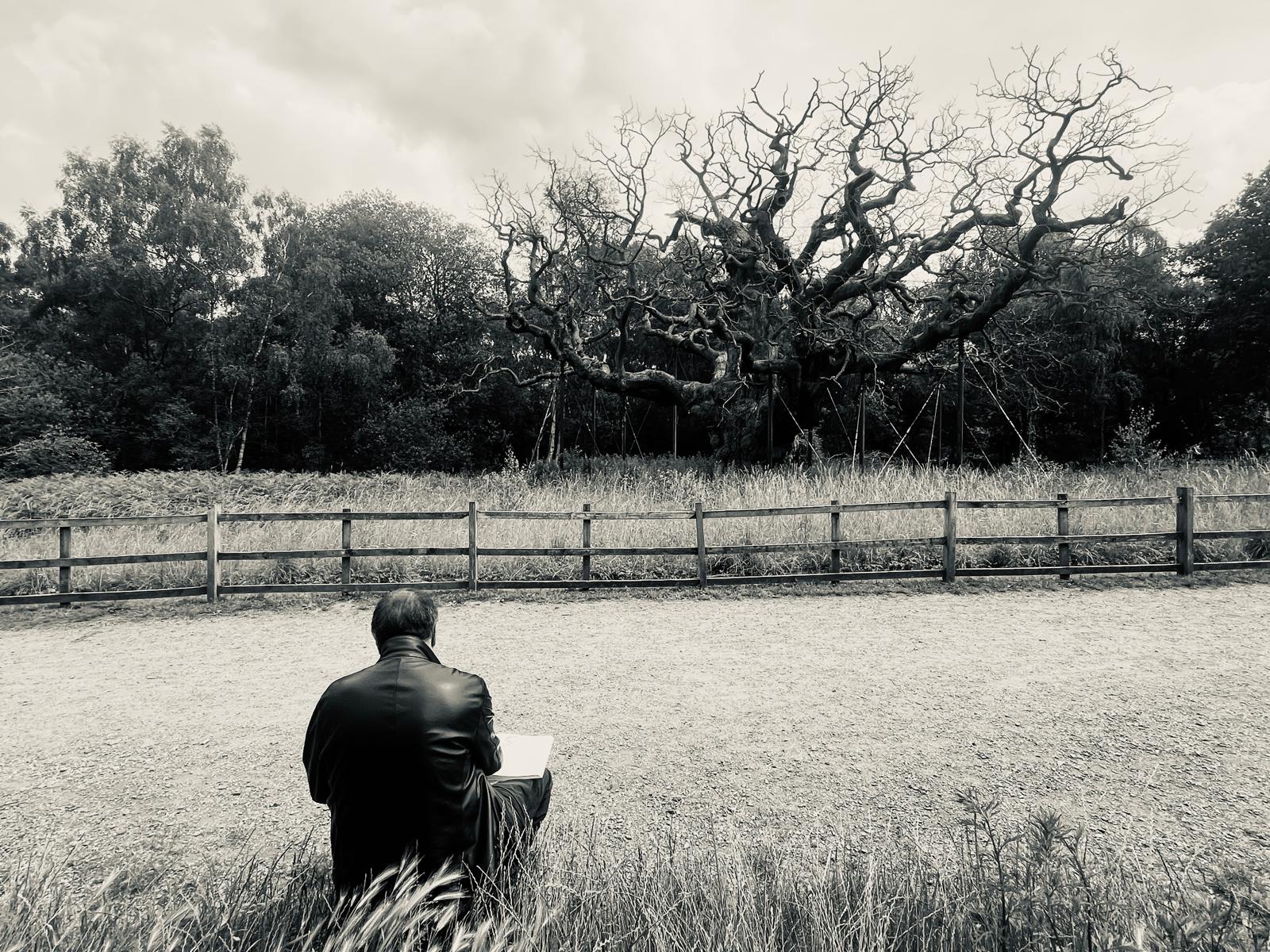
The visit to Sherwood Forest felt like another such encounter. Weiwei arrived carrying a small stool and a prototype of the exhibition catalogue containing blank pages. Sitting beneath the Major Oak, he began to draw, producing what was, remarkably, his first drawing in approximately 40 years. Whether this moment had been anticipated remains impossible to know. Did he bring the catalogue because he already envisaged the drawing finding its way into the final publication, or did he simply reach for the nearest object with blank pages before leaving the hotel that morning? With Weiwei, such questions are rarely straightforward. The line between coincidence and intention is often impossible to locate, with significance revealing itself only in retrospect.
Standing beneath the Major Oak, you find yourself thinking about the countless individuals who must have gathered around it over the course of its lifetime. Trees have always attracted acts of remembrance. People carve initials into bark, swing from its branches, tell stories and return years later hoping to find some trace of themselves still present. In this sense, a tree functions not unlike an archive, quietly accumulating evidence of human lives as they pass through it. The Major Oak carries within it far more than its own lifespan for it contains the projections, myths, encounters and memories of generations who stood beneath its branches long before our arrival.
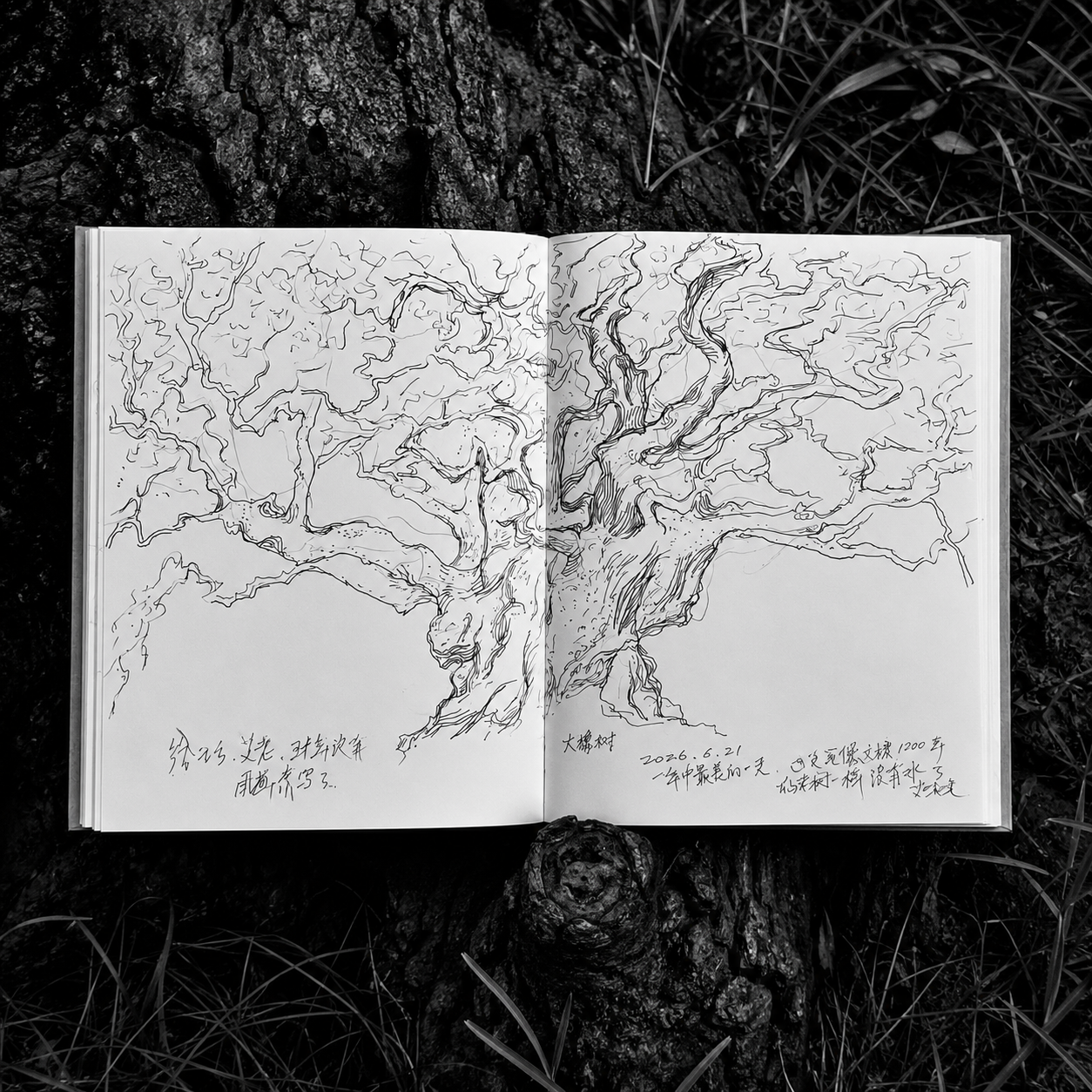
It was only on the journey back to Manchester that I remembered the date. The Summer Solstice had also been Father’s Day. When I pointed this out, Weiwei dismissed the observation with characteristic indifference. Yet considering how frequently our conversations had returned to Ai Qing throughout the day, the coincidence felt difficult for me to ignore. Here was a son standing beneath a dying tree in the English countryside while preparing what he himself described as his largest exhibition in Britain, and perhaps his last. 86 years earlier, his father had written a poem about trees whose roots intertwine beneath the earth. Whether meaningful or entirely incidental, the connection lingered. On Father’s Day, that poem seemed to surface again in an entirely unexpected form.
Perhaps this is why the visit felt significant. Not because the Major Oak will necessarily become a work of art, but because it revealed something already present throughout the exhibition. The ancestral hall, the buttons, the bombs, the refugee vessels and the tree all carry histories larger than themselves. Each has survived long enough to become a witness to the world that produced it. Standing beneath the oak, I was reminded that history is rarely preserved in the abstract. It survives through objects, places and stories that continue to carry traces of human experience long after their original context has disappeared.
On the longest day of the year, we travelled to visit one of Britain’s longest surviving witnesses. Looking back, what stays with me is not the death of the tree but the encounter itself. A poem written in wartime China, a 400-year-old ancestral hall, thousands of buttons sewn together in Manchester and a dying oak tree in Sherwood Forest seem, at first glance, to have little in common. Yet beneath the surface they belong to the same conversation. If Ai Qing’s poem teaches us anything, it is that the most important connections are rarely the most visible ones. They exist beneath the surface, quietly linking people, places and histories across time. Perhaps that is why Weiwei was drawn to the Major Oak in the first place. Not because it had died, but because it had lived long enough to see.