
fbpx Ai Weiwei | CIRCA

Ai Weiwei is one of the most influential artists and public intellectuals of the twenty-first century. Working across sculpture, architecture, film, installation, publishing and social activism, he has built a practice that examines the relationship between the individual and structures of power. Drawing upon conceptual art, Chinese history, craftsmanship and contemporary politics, his work transforms objects, images and public interventions into powerful reflections on freedom, authority, memory and human rights.

Over four decades, Weiwei has created some of the defining works of contemporary culture. From Dropping a Han Dynasty Urn (1995), which challenged accepted notions of cultural value and preservation, to Sunflower Seeds (2010), his monumental installation of millions of hand-crafted porcelain seeds at Tate Modern, his work repeatedly questions how histories are constructed and who controls them. Projects including Remembering (2009) and Straight (2008–12) emerged from his investigation into the Sichuan earthquake, combining artistic practice with civic activism to confront questions of accountability, truth and remembrance. More recently, films such as Human Flow (2017) have expanded his focus towards migration, displacement and the movement of people across borders, reflecting a sustained concern for the dignity and rights of individuals worldwide.

Ai Weiwei has been closely connected to CIRCA since its inception. In October 2020, he became the first artist to launch the platform, helping establish a new model for public art that places creativity, dialogue and participation at the centre of everyday life. Since then, he has remained a defining presence within CIRCA’s history, returning through multiple collaborations that have engaged global audiences in conversations about freedom, responsibility and the role of the artist in society.

In 2024, Weiwei returned to launch CIRCA 20:24 with Ai vs AI, an 81-day public enquiry into artificial intelligence, authority and the freedom to ask questions. Marking the first time he used artificial intelligence as a creative counterpart, the project transformed public space into a forum for philosophical dialogue, inviting audiences to submit questions while exploring the changing relationship between technology, knowledge and human agency. At its core was a principle that has guided his work throughout his career: that critical inquiry remains an essential expression of freedom.

Born in Beijing in 1957, Ai Weiwei lives and works internationally. Through a practice that bridges art, activism and public life, he continues to challenge assumptions, provoke debate and inspire audiences around the world to reconsider the systems that shape contemporary society.


Circa Commissions

Ai Weiwei, Ai vs AI

In our questions, more so than any answers, we can find the map of the human mind. We ask questions in search of learning and understanding, says Ai Weiwei, dividing ourselves from systems of Artificial Intelligence (AI) that lack interior identities. The questions we ask reveal our humanity and preoccupations, further distancing the human questioner from machine systems, which have no life story, no personhood from which any sincere question can arise. Ai Weiwei’s 81 questions are both the continuation of a deep history of rational and spiritual inquiry as well as an innately idiosyncratic autoportrait.

View more

Ai Weiwei, CIRCA 2020

CIRCA 2020 inaugurates a new proposition for public space. Each evening at 20:20 GMT, one of the world’s most recognisable advertising screens pauses its commercial programming and becomes a platform for contemporary art. Taking its name from both the year in which it is conceived and the curatorial premise that underpins it, CIRCA invites artists to consider the world as it unfolds around us: circa now. The timing is significant. October 2020 arrives amid a period of profound uncertainty. Across much of the world, public life has been reshaped by the COVID-19 pandemic. Movement is restricted, institutions are under pressure…

View more

ESSAY

Ai Weiwei’s Hope in The Jaws Of The Monster by Matthew Ponsford
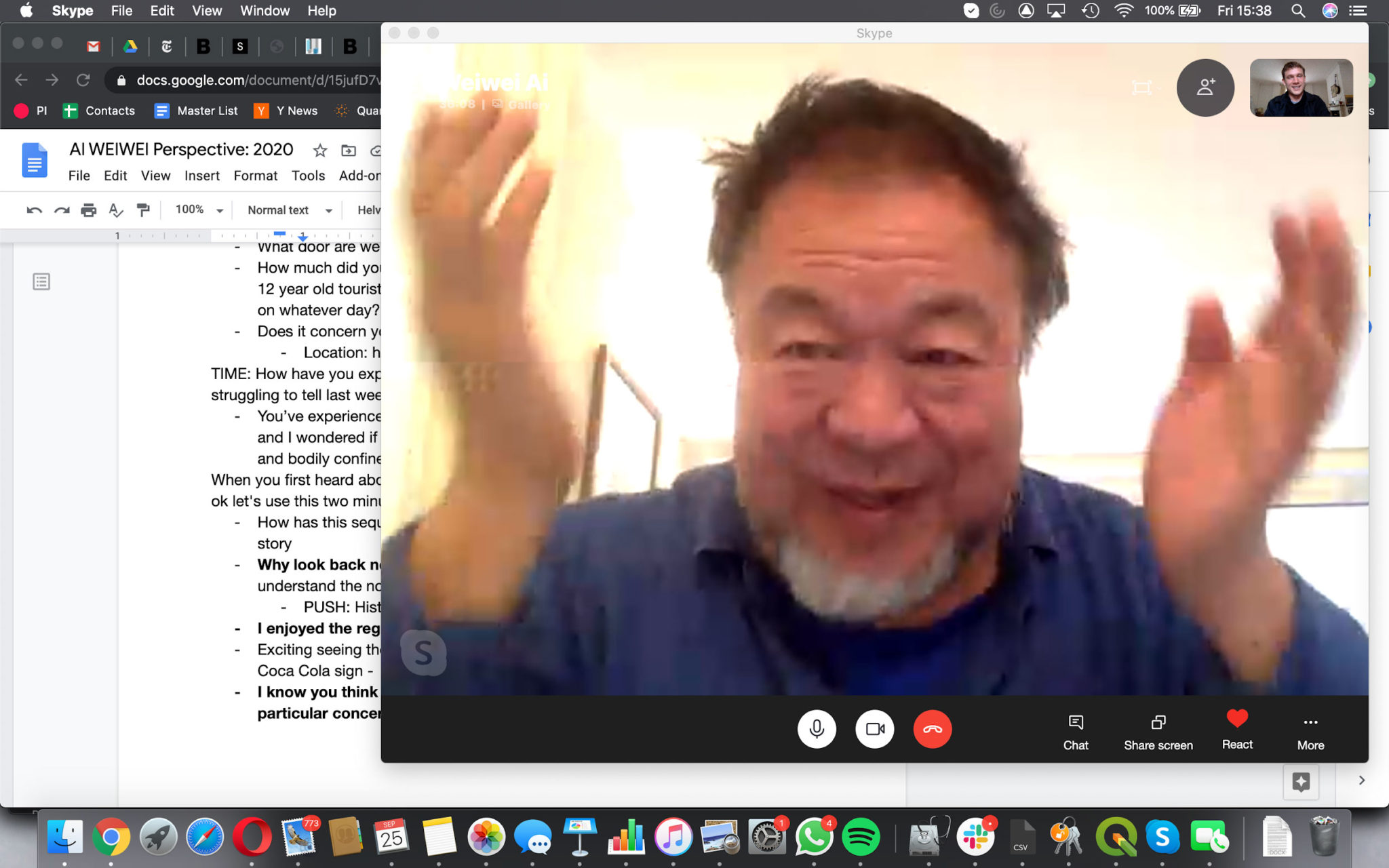
01 OCT 2020: ‘I loved New York—every inch of it. It was like a monster.’

In the story Ai Weiwei tells, there’s always got to be a monster. In New York – where his new series of films for CIRCA 2020 begin, amid street protests that set in motion his journey toward human rights activism – the city convulses like a beast. He writes in his diary after interrogation by a Chinese prison guard that it is always a monster that draws the soldier to a fight, and without this foe, the soldier has no identity. And the monster, he explains, is what we’re fighting today.

And yet the story he tells, again and again, teeters with hope, with personal joy, and even with belief in miracles. The moral, as it begins to appear, seems to be: the monster is not simply the totalitarian, not simply a power stronger than all of us. But we can’t win until we know what the monster is made of.

Shop

Loading variants...

More from Ai Weiwei

Subscribe to our newsletter

Subscription successful

An error occurred