fbpx Pussy Riot, Nadya Means Hope | CIRCA

CIRCA 20:23

Pussy Riot, Nadya Means Hope

8 March - 5 April

In many Slavic languages, the name Nadya means hope. For Nadezhda Tolokonnikova, hope is neither an abstract ideal nor a comforting sentiment. It is something forged through confrontation. Through resistance. Through the refusal to accept that the structures governing our lives are immutable. It is a principle tested against prisons, censorship, war and the continual struggle for bodily autonomy. Hope, in Tolokonnikova’s work, is not passive. It acts.

Over the past decade, Nadya has become one of the defining artistic and political voices of her generation. As a founding member of Pussy Riot, she transformed performance into a tool for direct intervention, collapsing the distance between art and political reality. Her imprisonment following the group’s 2012 Punk Prayer protest inside Moscow’s Cathedral of Christ the Saviour established her not simply as an artist responding to power, but as someone willing to place her own freedom at risk in order to challenge it.

Presented on the occasion of International Women’s Day, Nadya Means Hope emerges from this history while confronting a new moment of global uncertainty. The work follows a year in which long-established rights and freedoms appeared increasingly vulnerable. The overturning of Roe v. Wade in the United States, the violent repression of women-led protests in Iran, the ongoing devastation of war in Ukraine and the continued resurgence of authoritarian politics around the world have exposed how fragile progress can be when confronted by entrenched systems of power.

For Tolokonnikova, these struggles are connected. They belong to a longer history in which women’s bodies, voices and lives remain subject to political control. As she has frequently observed, laws may change overnight, but culture changes far more slowly. Patriarchy survives not simply through legislation but through symbols, language, institutions and habits of thought that reproduce themselves across generations.

It is these invisible structures that Nadya Means Hope seeks to illuminate.

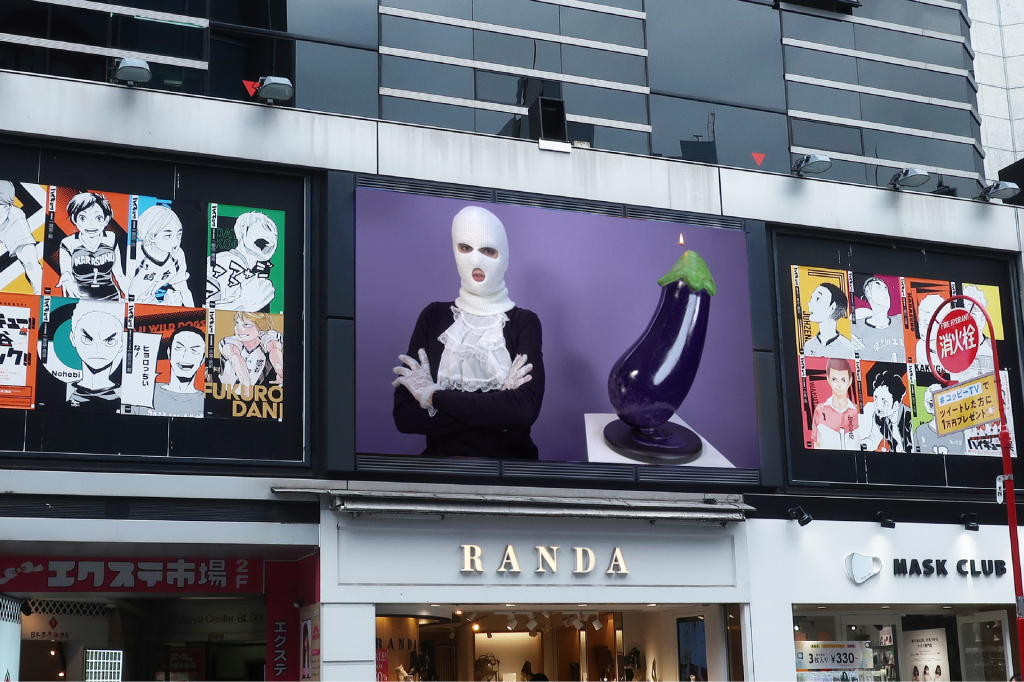
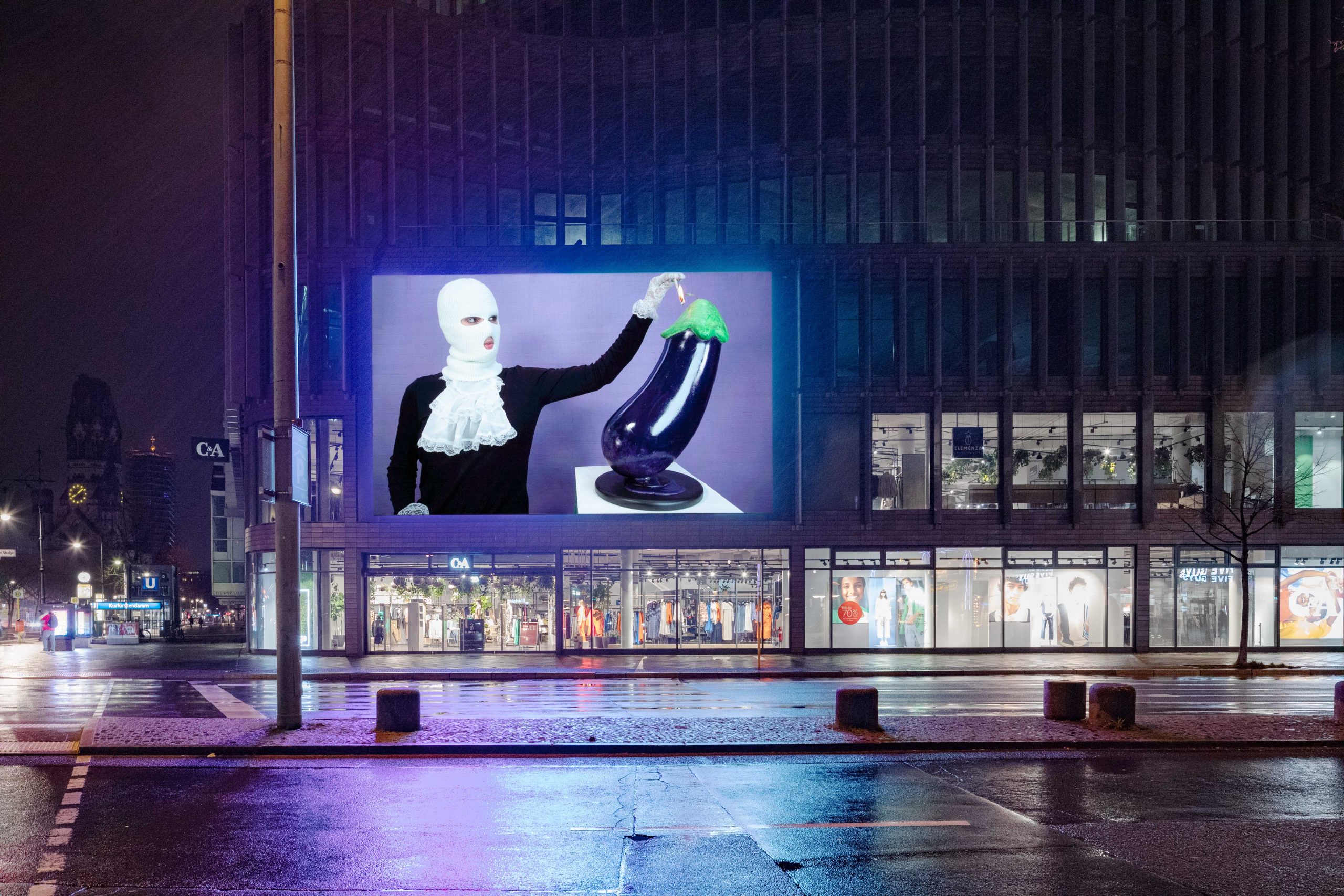
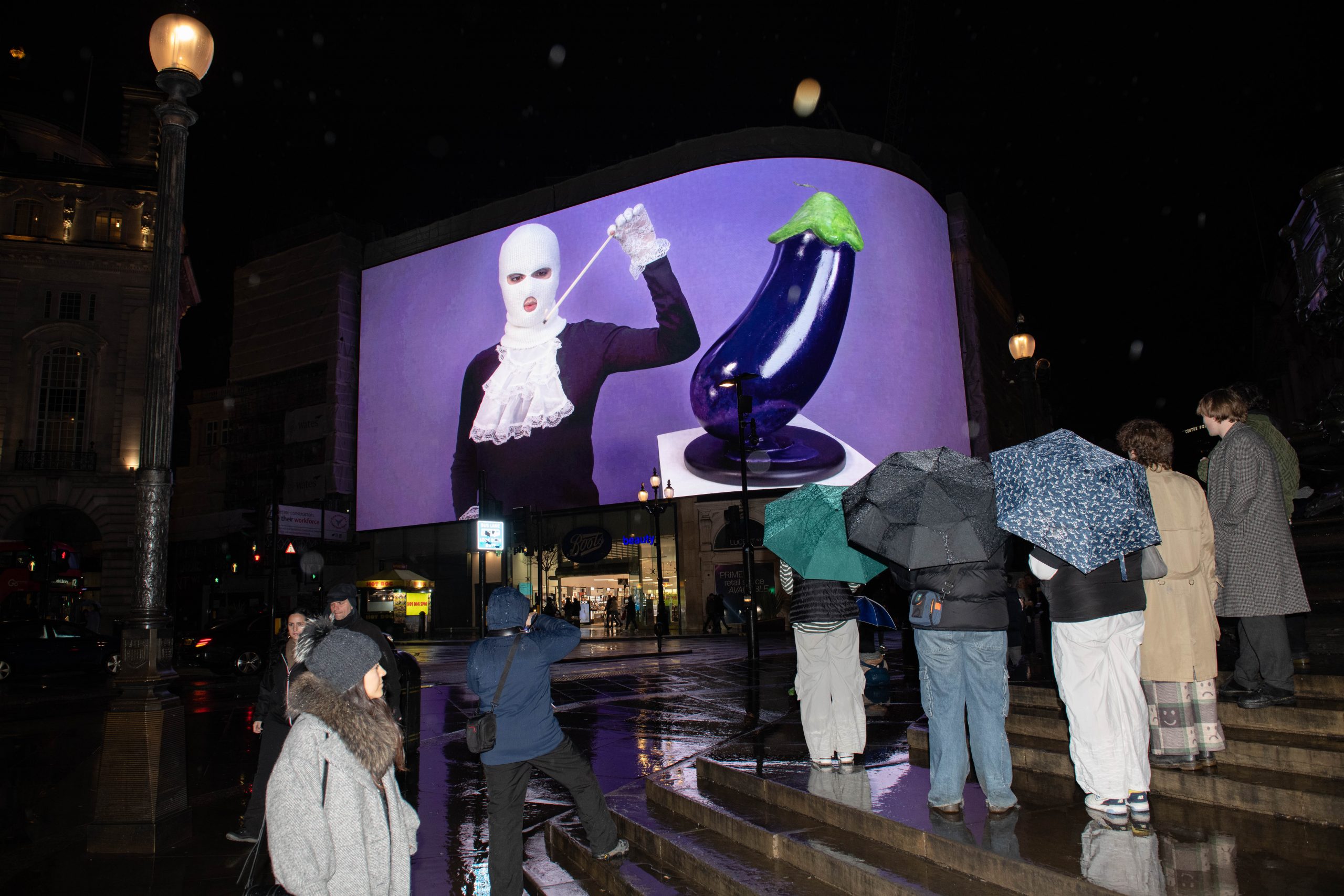
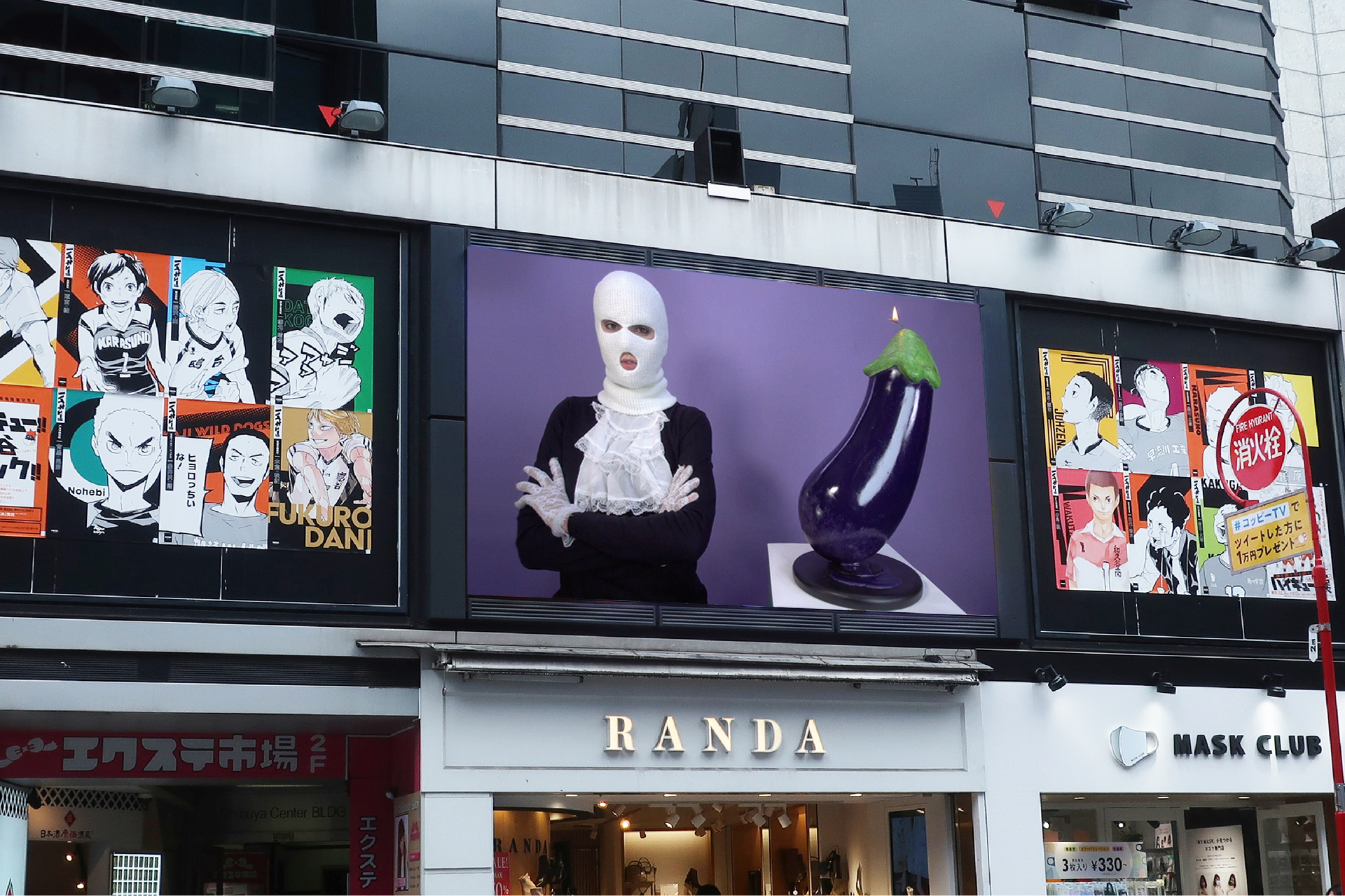
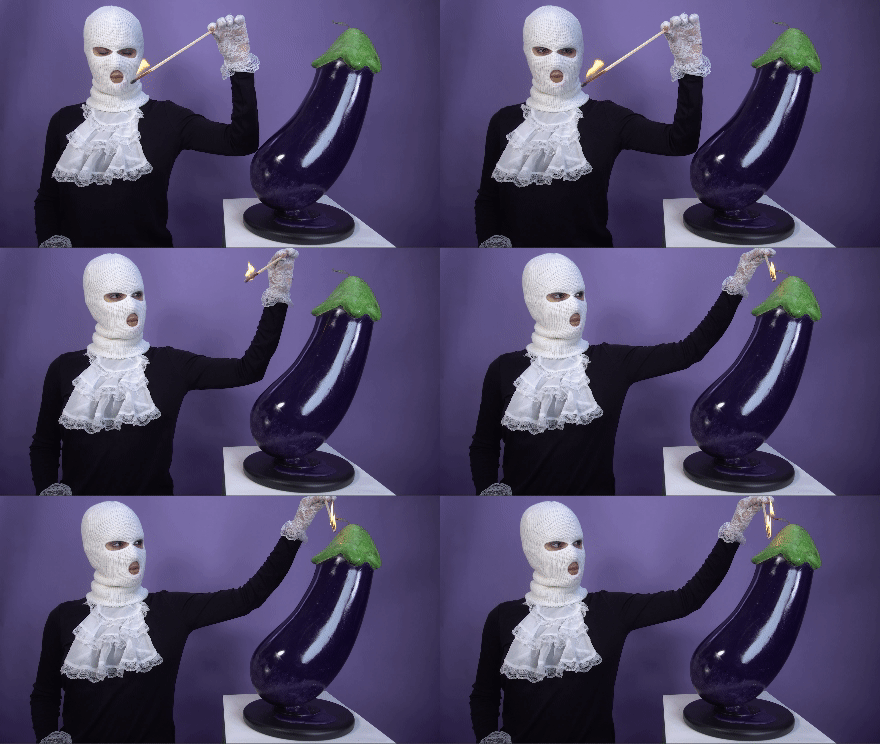
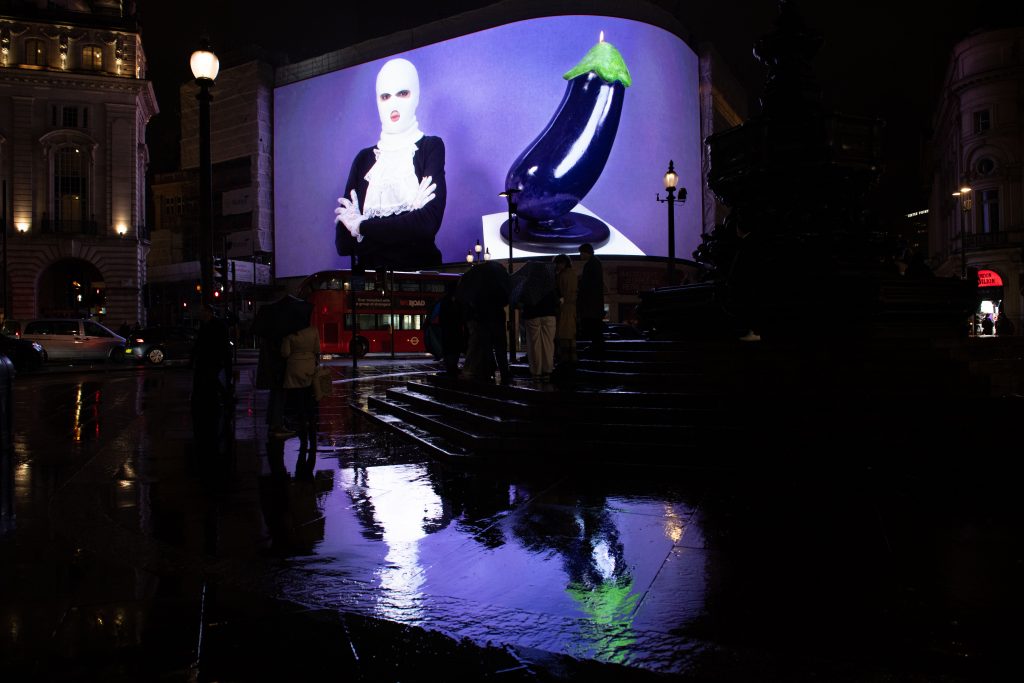
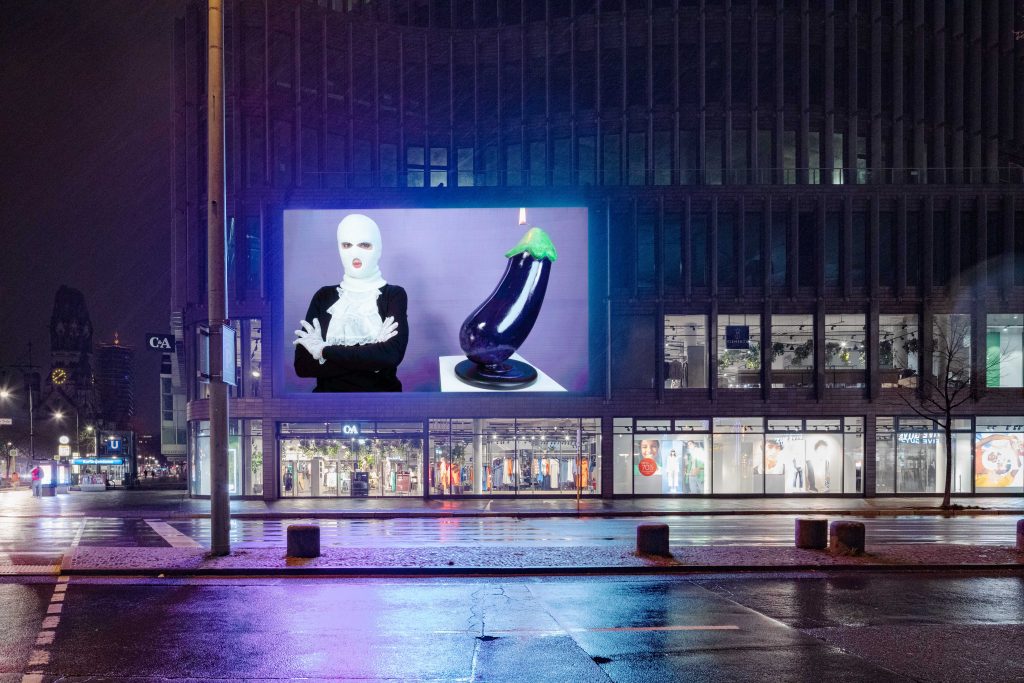
Dressed in the white balaclava synonymous with Pussy Riot, Tolokonnikova faces the viewer directly. The gesture is confrontational but also intimate. She strikes a match and ignites the tip of a purple candle sculpture modelled on the now universally recognised eggplant emoji. Simultaneously comic and unsettling, the object functions as a contemporary monument to phallocentrism, a system in which political, economic and cultural authority remains organised around masculine power. The sculpture burns slowly. Wax softens. Form dissolves.

The gesture is deliberately simple. Yet like much of Tolokonnikova’s practice, it operates through the strategic deployment of humour. Absurdity becomes a weapon. Satire punctures authority. The work belongs to a lineage of feminist artists who understand that ridicule can often destabilise power more effectively than outrage alone. By transforming a ubiquitous digital symbol into an object of ritual combustion, Tolokonnikova exposes the fragility hidden beneath systems that present themselves as permanent.

The use of the emoji is equally significant. For Tolokonnikova, emojis constitute a new global language, capable of transcending national borders, ideologies and traditional forms of communication. The eggplant emoji is instantly recognisable across cultures, making it an ideal symbol through which to discuss the persistence of patriarchal structures in an increasingly networked world. The work speaks in the visual vernacular of the internet while addressing questions that are centuries old.

Yet despite its critique, Nadya Means Hope ultimately resists despair. The title itself acts as both declaration and challenge. Hope appears not as naïve optimism but as a political necessity. It survives in those who continue to organise, protest, create and care despite overwhelming circumstances. It survives in the women leading movements for freedom in Iran. It survives in activists defending reproductive rights. It survives in those resisting war, censorship and authoritarianism in all its forms.

Broadcast across CIRCA’s global network of public screens, the work transforms spaces typically devoted to consumption into sites of collective reflection. The billboard, a structure traditionally used to manufacture desire, becomes a platform for dissent. The language of advertising is redirected toward questions of power, autonomy and liberation.

At its core, Nadya Means Hope asks whether hope itself can remain a radical force in an era defined by uncertainty. Tolokonnikova’s answer is neither sentimental nor abstract. Hope survives whenever individuals refuse to surrender their agency to systems that seek to define them.


Shop

Loading products...

Films

Michelangelo Pistoletto’s Three Mirrors is presented daily across CIRCA’s global network of public screens. Each evening at 20:26 (local time), the work appears simultaneously across the following locations, entering the flow of the city and inviting a shared moment of reflection. Select a location below to view directions and find your nearest screen on Google Maps.

London, Piccadilly Lights

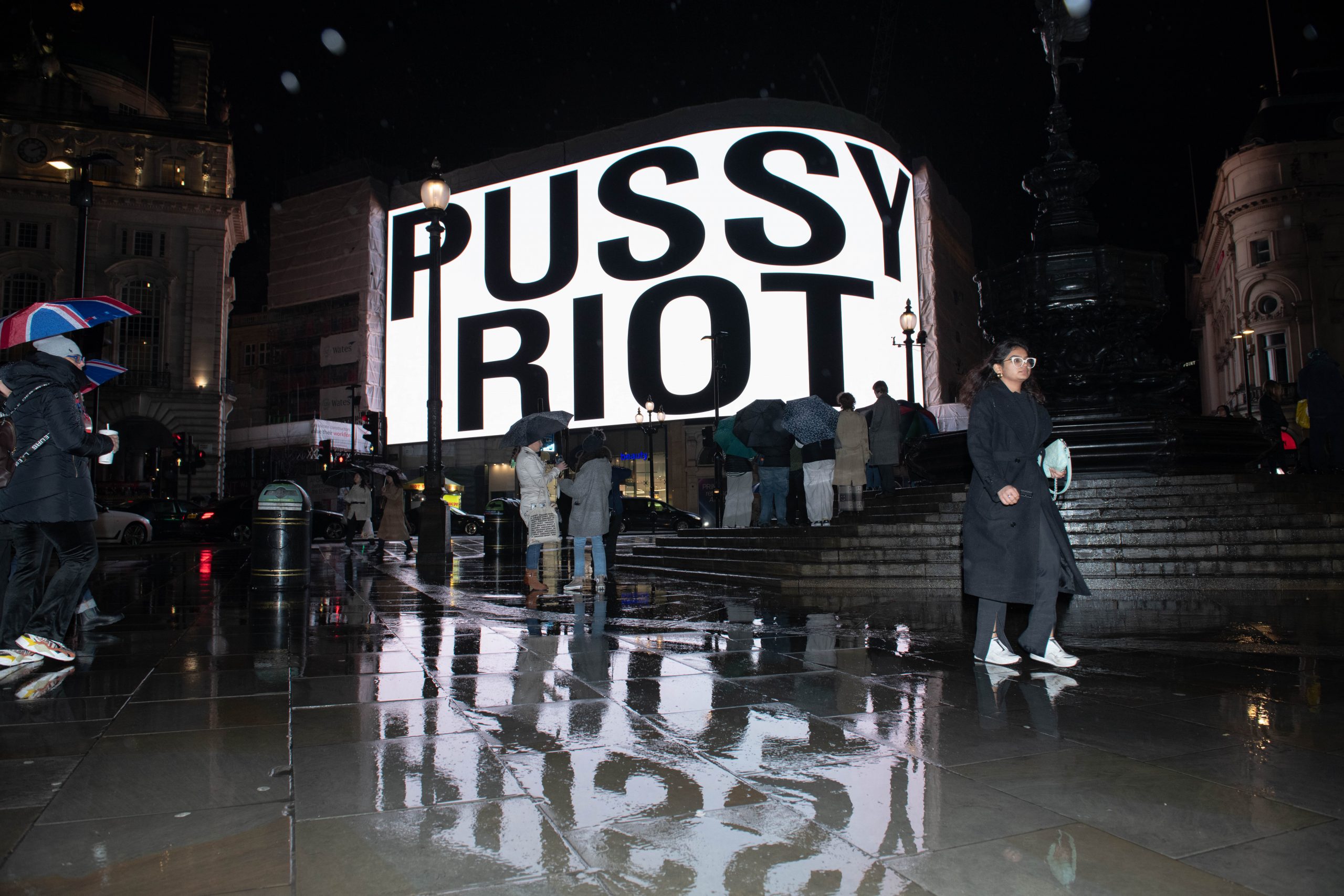
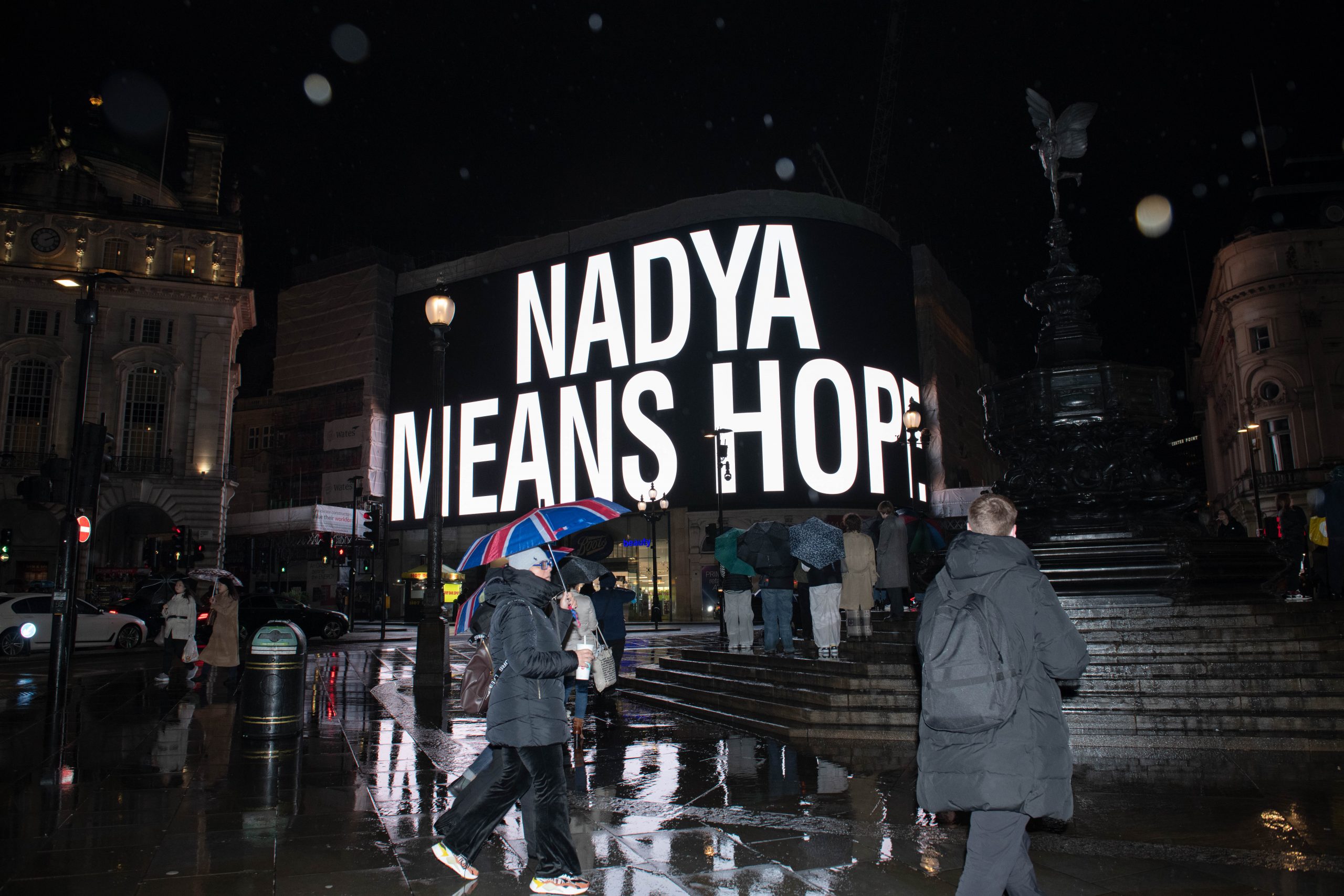
Experience  Nadya Means Hope by Pussy Riot every evening at 20:23 GMT/BST (8 March-5 April 2023) on the iconic Piccadilly Lights screen.

View screen locations

Berlin, Kurfürstendamm

Experience  Nadya Means Hope by Pussy Riot every evening at 20:23 CET (8 March-5 April 2023) on Berlin’s Limes Kurfürstendamm screen.

View screen locations

Tokyo, NEO Shibuya TV

Experience  Nadya Means Hope by Pussy Riot every evening at 20:23 JST (13-19 March 2023) on the NeoShibuya screens in Shibuya Crossing.

View screen locations

ESSAY

Pussy Riot: The Bold And The Hopeful by Mimi Nguyen
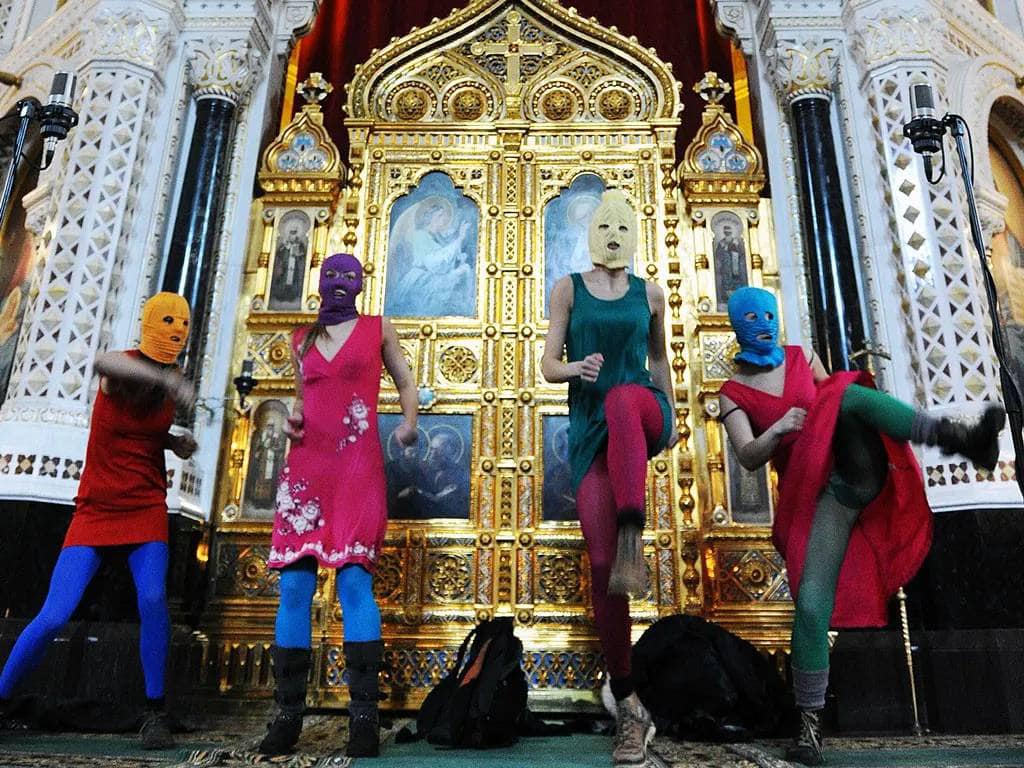
In her new CIRCA 20:23 commission, ‘Nadya Means Hope,’ the artist and activist Nadya Tolonnikova reckons with how artistic gestures can achieve so much more than just aesthetic pleasure.

“I know that so many people in Russia actually want to choose the Western way of living. Which is more pleasant and civilised. I mean, I wouldn’t say civilised, fuck this word, more pleasant, to me personally. I’m not gonna get shot in the street for expressing my freedom of speech, right?” – said artist and activist Nadya Tolokonnikova, who was jailed in 2012 with two other members of Pussy Riot after they staged a protest against the Russian Orthodox Church’s and the Russian government. Tolonnikova traces back to me the rich Russian feminism history, with women fighting and successfully achieving the right to vote in 1917, following the revolution. The early socialist government also implemented progressive reforms for gender equality. However, with the rise of Stalinism, the government became violent, oppressive, and patriarchal. Tolokonnikova sees echoes of the early feminist movement in Russia today.
Press

HypeBeast
Artnet
Press Release

Biography

Pussy Riot (Nadya Tolokonnikova)

Nadya Tolokonnikova is an artist, activist and founder of the feminist protest collective Pussy Riot. Working at the intersection of performance, music, visual art and political action, her practice challenges authoritarianism, censorship and systems of power, transforming acts of resistance into works of cultural significance. For more than a decade, she has been one of the most recognisable voices advocating for freedom of expression, gender equality and human rights.

Born in Norilsk, Siberia, Tolokonnikova co-founded Pussy Riot in 2011, a radical feminist art collective whose interventions combined performance, protest and political critique. International attention followed Punk Prayer (2012), the anti-authoritarian performance that led to her imprisonment in a Russian penal colony. Rather than silencing her, the experience became a catalyst for an expanded practice spanning art, writing, music and activism. Through projects that move fluidly between galleries, public space and digital platforms, Tolokonnikova has continued to explore how creativity can become a tool for dissent, solidarity and social change.

Nadya’s relationship with CIRCA reflects a shared belief in the power of public art to confront urgent political realities. In 2023, she presented Nadya Means Hope, a major public commission broadcast across CIRCA’s global network of screens. Combining personal testimony with a wider call for resistance and collective action, the work transformed public space into a platform for dialogue about freedom, courage and the responsibilities of citizenship. Alongside the commission, CIRCA published 50 One Dollar Bills, a large-scale screen print that reimagined the iconography of American currency through the lens of feminist activism, with proceeds supporting the Art Riot Fund.

Named among TIME Magazine’s most influential people and recognised internationally for her artistic and political activism, Tolokonnikova continues to redefine what art can achieve in the public sphere. Whether through performance, publishing, music or direct action, her work insists that creativity is not separate from politics, but one of its most powerful instruments.


Subscribe to our newsletter

Subscription successful

An error occurred