fbpx Vivienne Westwood, Don't Buy a Bomb | CIRCA 20:21

CIRCA 2021

Vivienne Westwood, Don’t Buy a Bomb

8 April, 2021

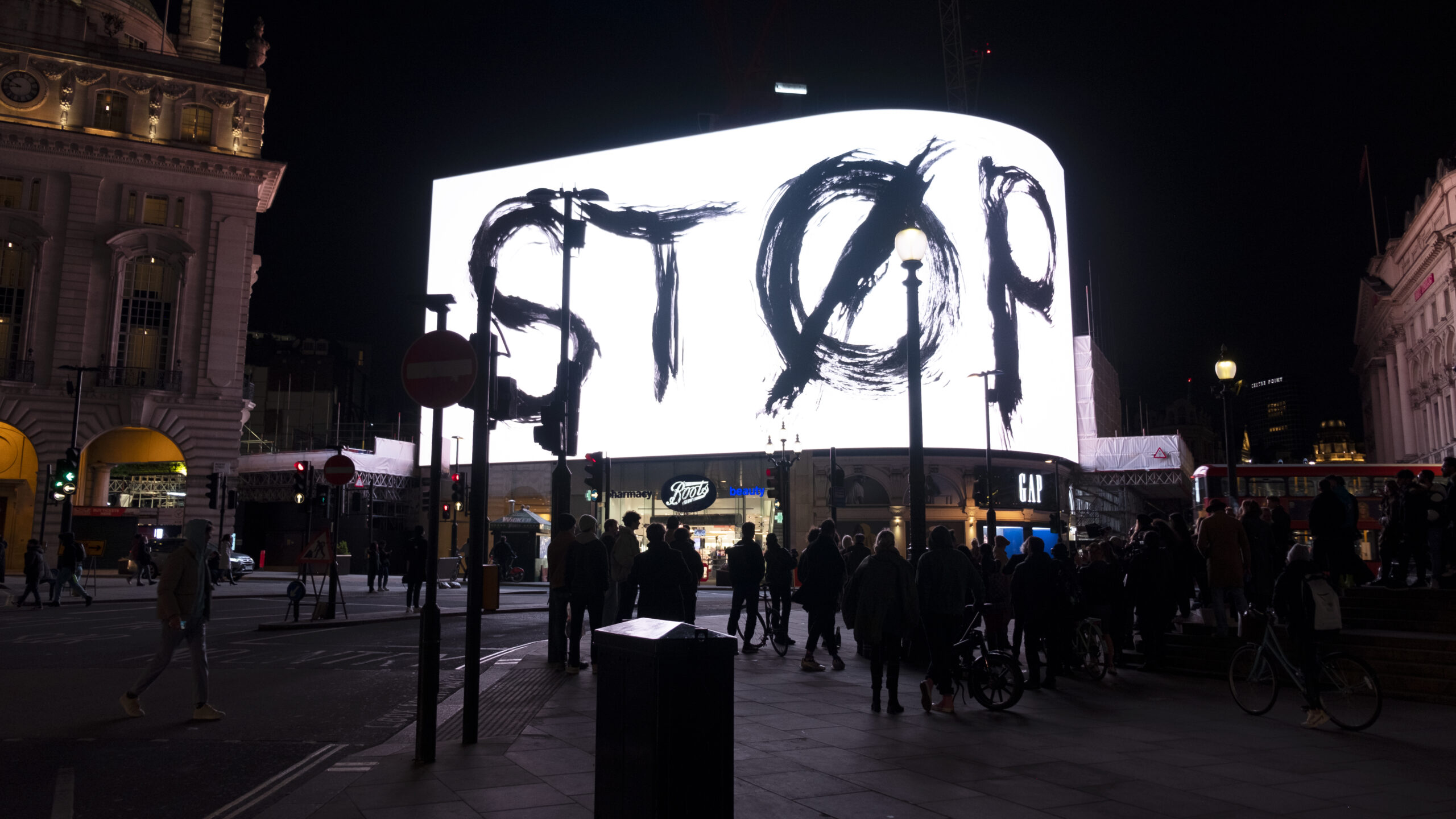
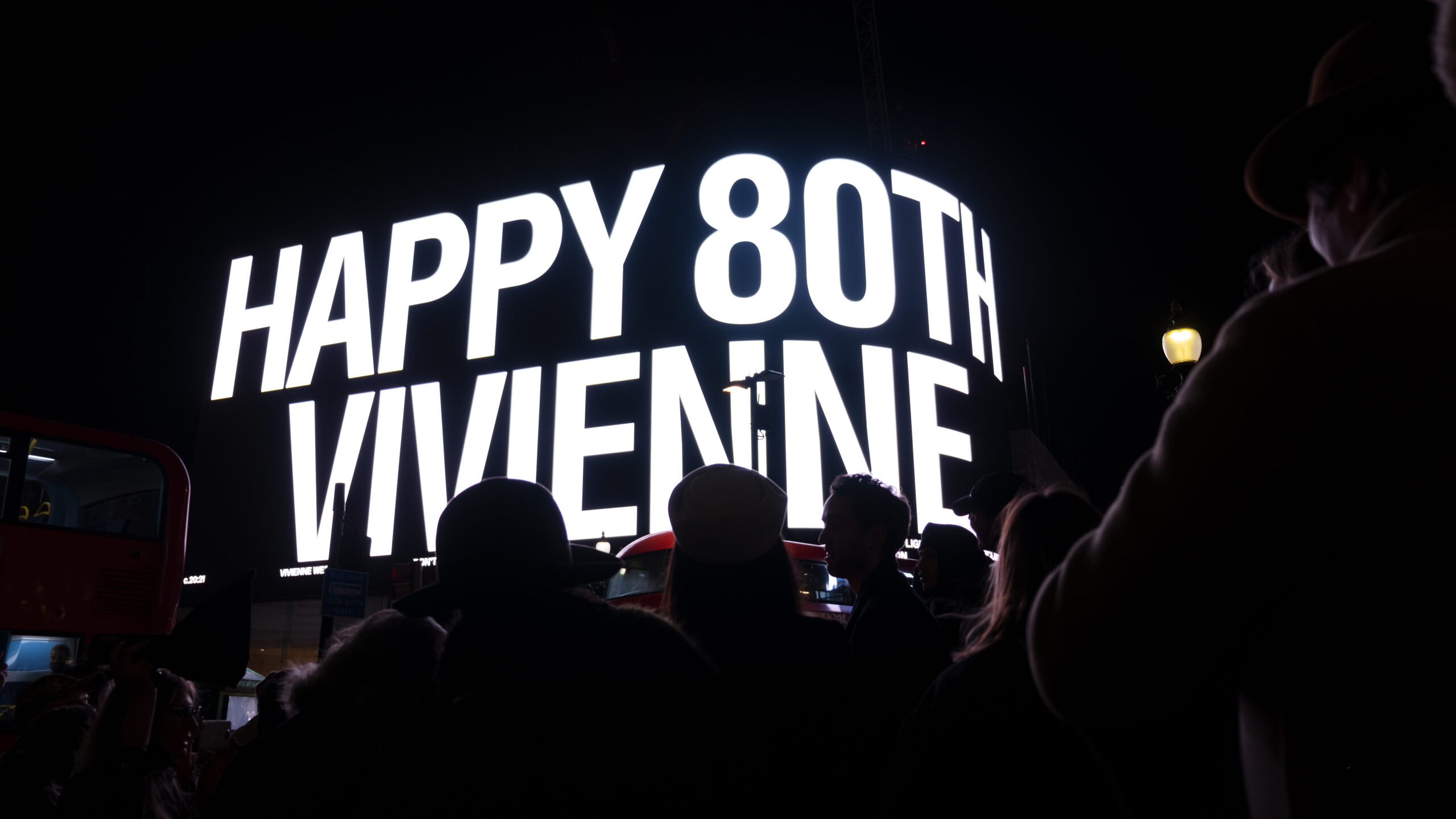
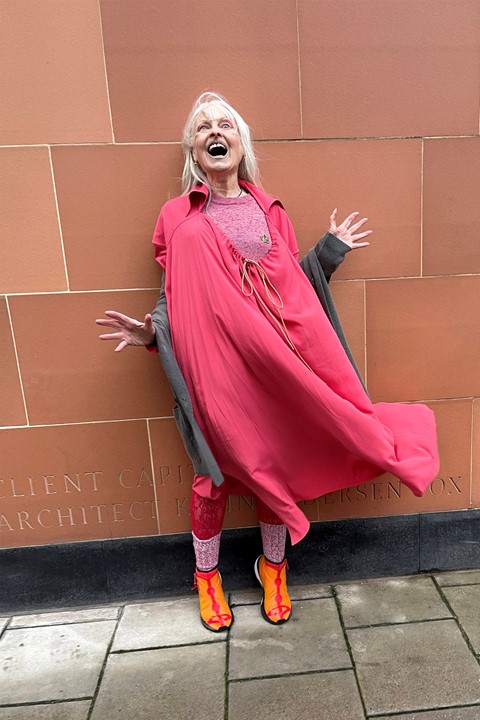
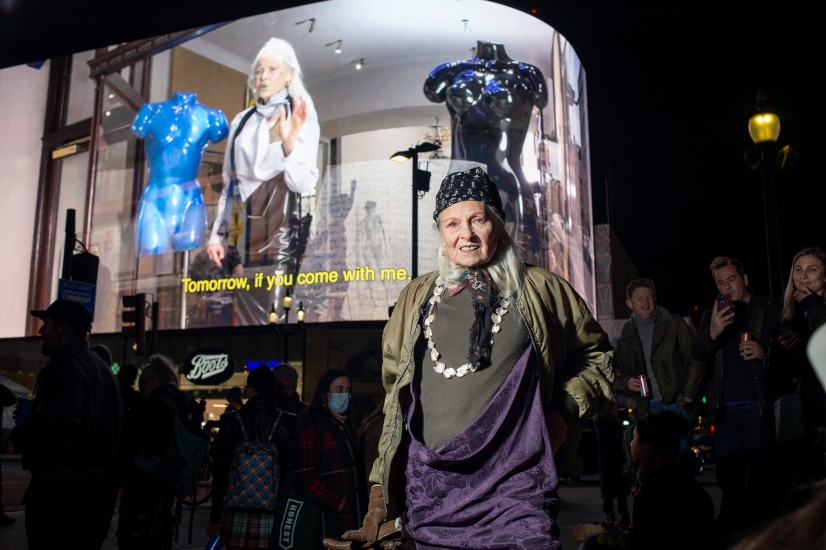
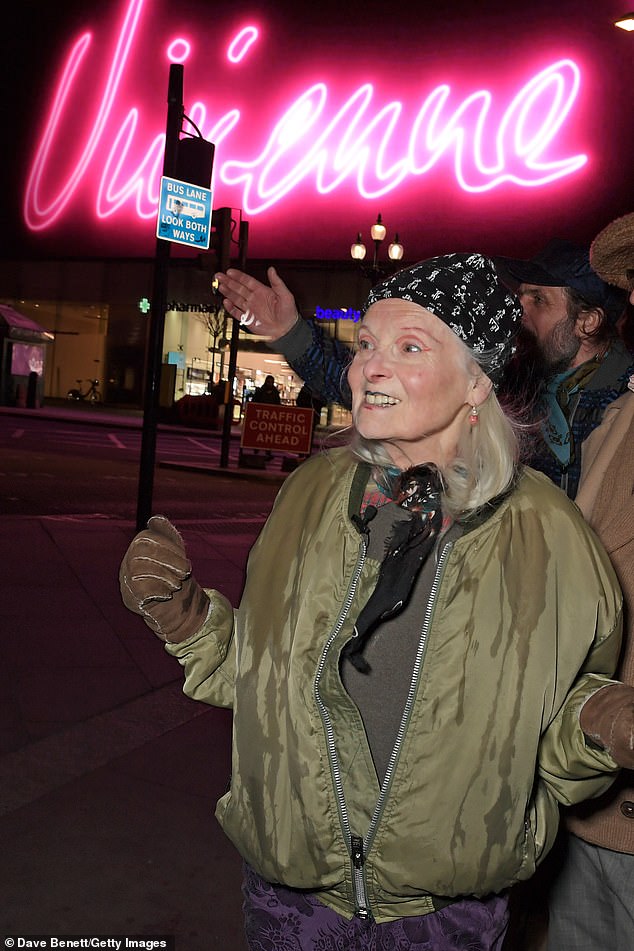
On 8 April 2021, Vivienne Westwood celebrates her 80th birthday not with a retrospective, a runway show, or a reflection on her extraordinary career, but with a call to action. Presented by CIRCA on the screens of Piccadilly Circus, Do Not Buy A Bomb transforms one of the world’s most visible advertising sites into a platform for dissent, delivering a message that draws together the defining concerns of Westwood’s later life: climate change, war, economic inequality and the responsibility of culture to imagine alternatives.

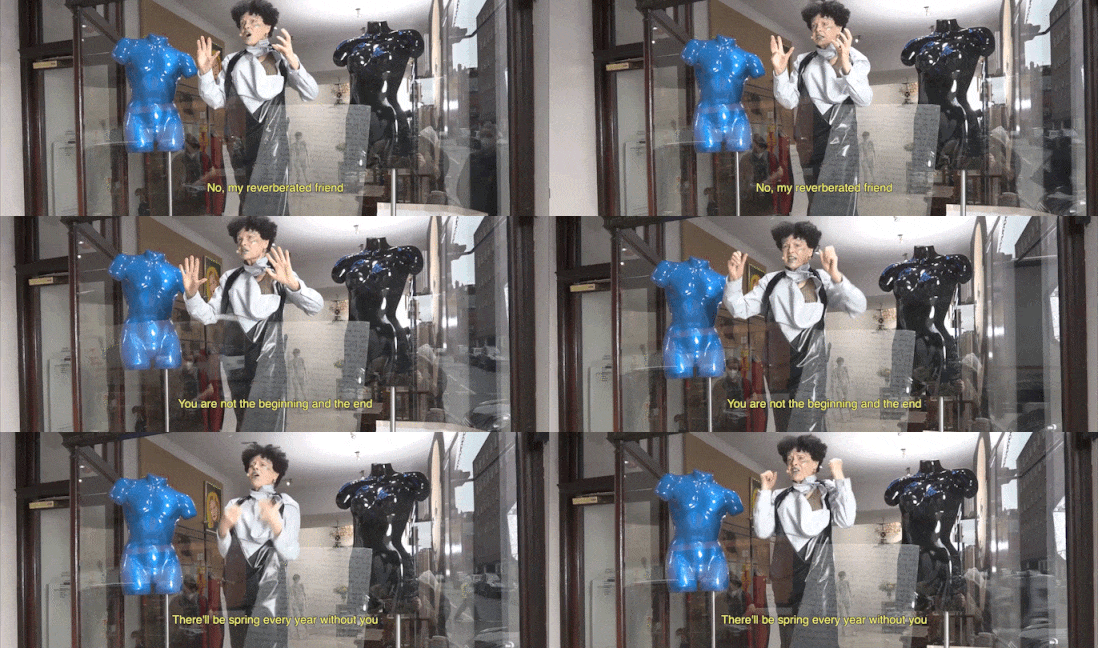
At the centre of the commission is a filmed performance in which Westwood presents a rewritten version of Without You from My Fair Lady. Part lament, part manifesto, the work unfolds as a direct address to the public, warning of environmental collapse while proposing a radically different vision for the future. “Capitalism is a war economy + war is the biggest polluter,” Westwood declares. “Therefore Stop War + change economy 2 fair distribution of wealth at the same time.”

The statement is characteristic of an artist who has always preferred provocation to consensus. Although celebrated as one of the most influential fashion designers of the modern era, Westwood’s practice has long extended beyond clothing. Throughout her career she has drawn upon art, literature, philosophy, history and political activism, treating fashion not as an end in itself but as a means of communication. From the moment she emerged in the 1970s, her work challenged accepted ideas of taste, authority and power. What began as a rebellion against convention gradually evolved into a broader critique of the social, political and economic structures shaping contemporary life.

There is a particular resonance to this message appearing in Piccadilly Circus. Long before it became synonymous with global advertising, the area occupied a central place in Britain’s cultural imagination. The neon lights of Piccadilly provided a backdrop for successive generations of youth culture, from the Mods of the 1960s to the Punks who would redefine British style in the decade that followed. Only a short distance away on the King’s Road, Westwood helped create the visual language of that movement, transforming clothing into an act of resistance and self-invention.

Half a century later, she returns to one of London’s most symbolic public stages. Yet the city she addresses is very different. The spaces once occupied by subcultures and countercultures are now dominated by the machinery of global commerce. Do Not Buy A Bomb exploits this contradiction with remarkable clarity. Appearing on a screen designed to stimulate desire and consumption, Westwood uses the platform to question the very economic system that sustains it. “U + I can’t stop war just like that. But we can stop arms production + that would halt climate change cc + financial Cra$h. Long term this will stop war.”

Whether understood as a political proposal, a utopian vision or an act of public agitation, the commission reflects a lifelong belief in the power of ideas to shape reality. Like the manifestos that have accompanied her work for decades, it asks audiences not simply to observe but to participate. Read. Think. Discuss. Act. “One day soon U will say the right thing 2 the right person at the right time + make a difference.”

Presented amid a global pandemic that has exposed the fragility of political and economic systems once assumed permanent, Do Not Buy A Bomb refuses nostalgia and rejects complacency. At eighty years old, Westwood is not interested in celebrating the past. Instead, she uses the occasion to address the future, insisting that culture remains a site of possibility and that imagination remains a political force. “I have always combined fashion with activism: the one helps the other. Maybe fashion can Stop War.”

In that sense, Do Not Buy A Bomb stands as a continuation of the project that has animated Westwood’s life and work from the beginning. Not fashion as spectacle, but fashion as a vehicle for ideas. Not culture as entertainment, but culture as a catalyst for change. Presented beneath the lights of Piccadilly Circus, the commission returns to the spirit of rebellion that first shaped the area decades earlier and asks what forms of resistance might still be possible today.

Shop

Loading products...

Michelangelo Pistoletto’s Three Mirrors is presented daily across CIRCA’s global network of public screens. Each evening at 20:26 (local time), the work appears simultaneously across the following locations, entering the flow of the city and inviting a shared moment of reflection. Select a location below to view directions and find your nearest screen on Google Maps.

London, Piccadilly Lights

Experience  Don’t Buy a Bomb by Vivienne Westwood on her birthday, 8 April at 20:21 GMT on the iconic Piccadilly Lights screen.

View screen locations

STATEMENT

Vivienne Westwood: “I have a plan 2 save the world”
I have a plan 2 save the World. Capitalism is a war economy + war is the  biggest polluter, therefore Stop War + change economy 2 fair distribution of wealth at the same time: NO  MANS LAND. Let’s be clear, U + I can’t stop war just like that. But we can stop arms production + that  would halt climate change cc + financial Crash. Long term this will stop war.

April 8th is my 80th birthday. Please read the Manifesto + Diaries + follow the playing cards 2 find out how  life changing the new economy will be. Read over + again 2 realize how simple + radical the plan is, then  U will change your pattern of life + by talking U will support me in the fight.

One day soon U will say the right thing 2 the right person at the right time make a difference. Put this in  your features + columns, + on social media – as journalists U could become activists. I have always  combined fashion with activism: the one helps the other. Maybe fashion can Stop War.

‘Buy Less Choose Well Make it Last’ Don’t buy a car Don’t buy a bomb!

Follow me on climaterevolution.co.uk ‘Get a life!’.
Press

Press Release
The Guardian
WWD
SHOWstudio
GQ
Dazed
V Magazine
L'Officiel
W Magazine

Biography

Vivienne Westwood

Vivienne Westwood was one of the most influential cultural figures of the twentieth and twenty-first centuries. Renowned for revolutionising fashion through a practice that fused history, politics and rebellion, she transformed the runway into a platform for activism, using her global profile to campaign for environmental protection, civil liberties, human rights and peace.

Emerging from London’s punk movement of the 1970s, Westwood challenged conventions of taste, identity and power with a body of work that reshaped contemporary fashion. From her early collaborations with Malcolm McLaren to her internationally celebrated collections, she drew upon centuries of art, literature and political thought to create a visual language that was both radically subversive and deeply informed by cultural history. Throughout her career, she remained committed to the belief that culture and education could inspire meaningful social change.

Westwood’s relationship with CIRCA reflected this conviction. In 2021, on the occasion of her 80th birthday, she presented Do Not Buy A Bomb, a special public commission broadcast on Piccadilly Lights. Combining performance, music and political manifesto, the work delivered an urgent message linking war, environmental destruction and economic inequality, while calling for a fundamental reimagining of society’s priorities. Accompanied by a limited-edition publication, the project exemplified her lifelong determination to use creativity as a catalyst for public debate and collective action.

Beyond fashion, Westwood became one of the most recognisable activist voices of her generation, championing causes ranging from climate justice and anti-war movements to freedom of information and indigenous rights. Her campaigns, speeches and public interventions demonstrated an unwavering belief that artists and designers have a responsibility to engage with the world around them. Through a legacy that extends far beyond clothing, Vivienne Westwood remains an enduring symbol of creative resistance, independent thinking and the power of culture to challenge the status quo.


Subscribe to our newsletter

Subscription successful

An error occurred