fbpx Emma Talbot, Four Visions for a Hopeful Future | CIRCA 20:21

CIRCA 2021

Emma Talbot, Four Visions for a Hopeful Future

1-31 March, 2021

What does a hopeful future look like? More importantly, how might we begin to imagine one?

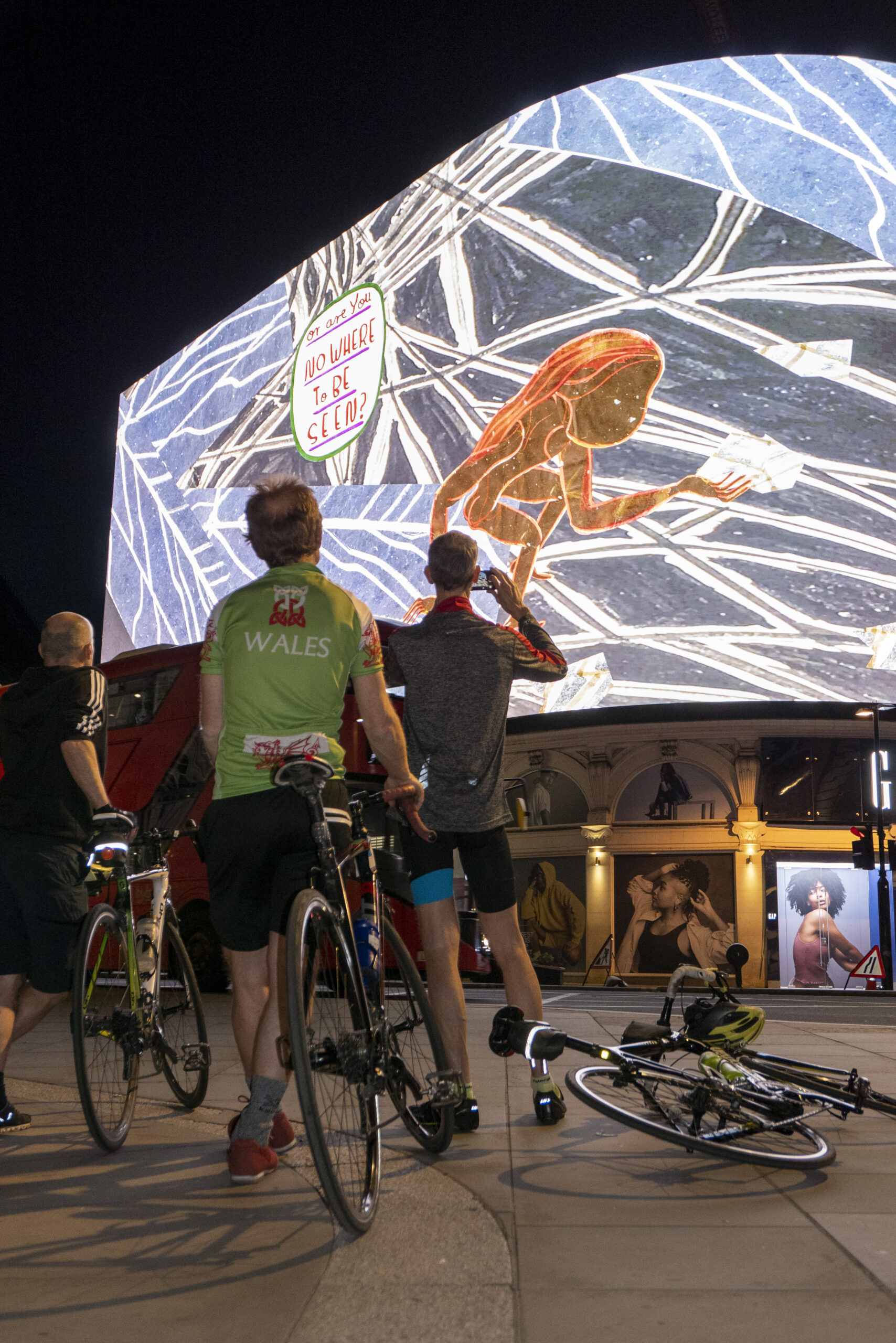
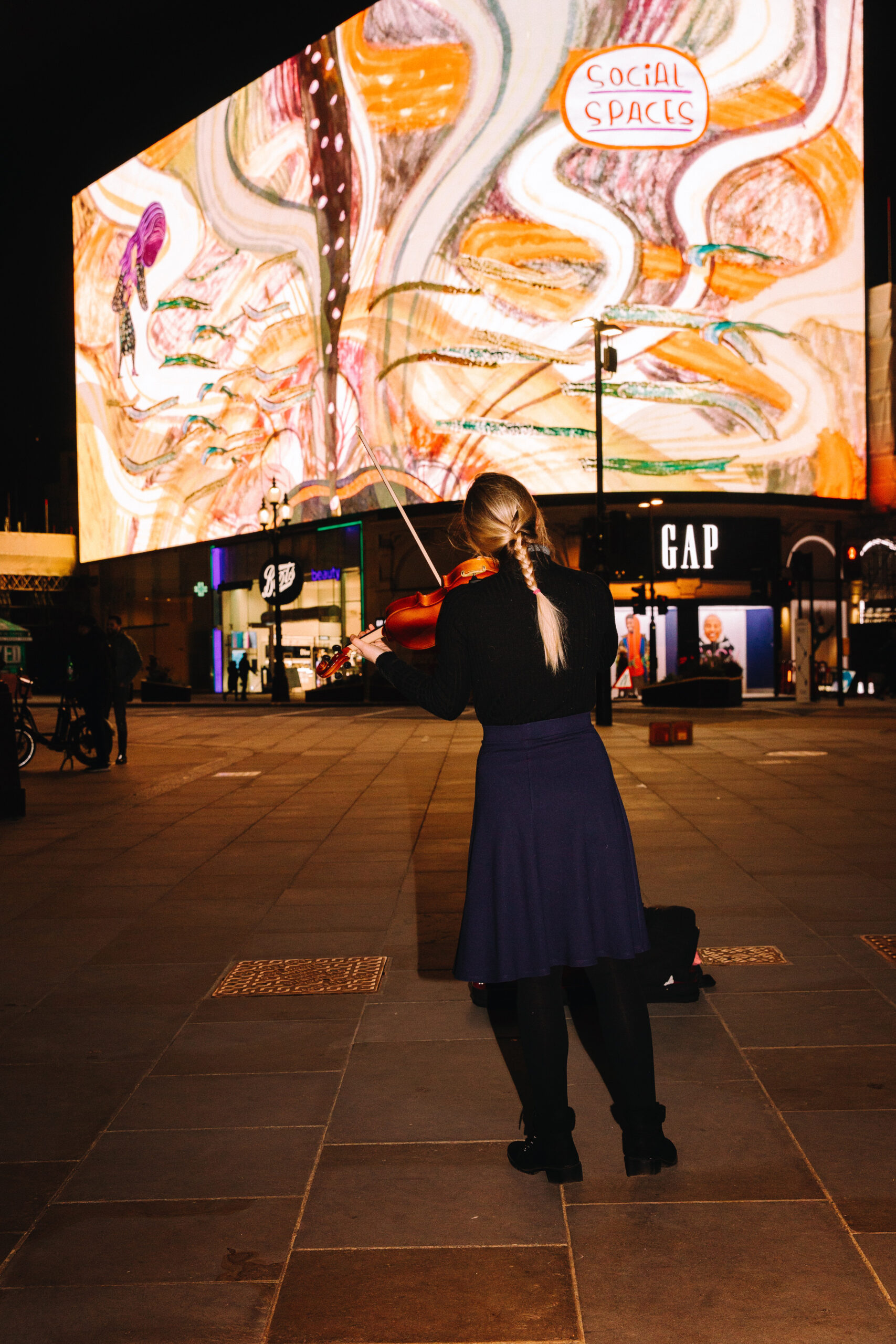
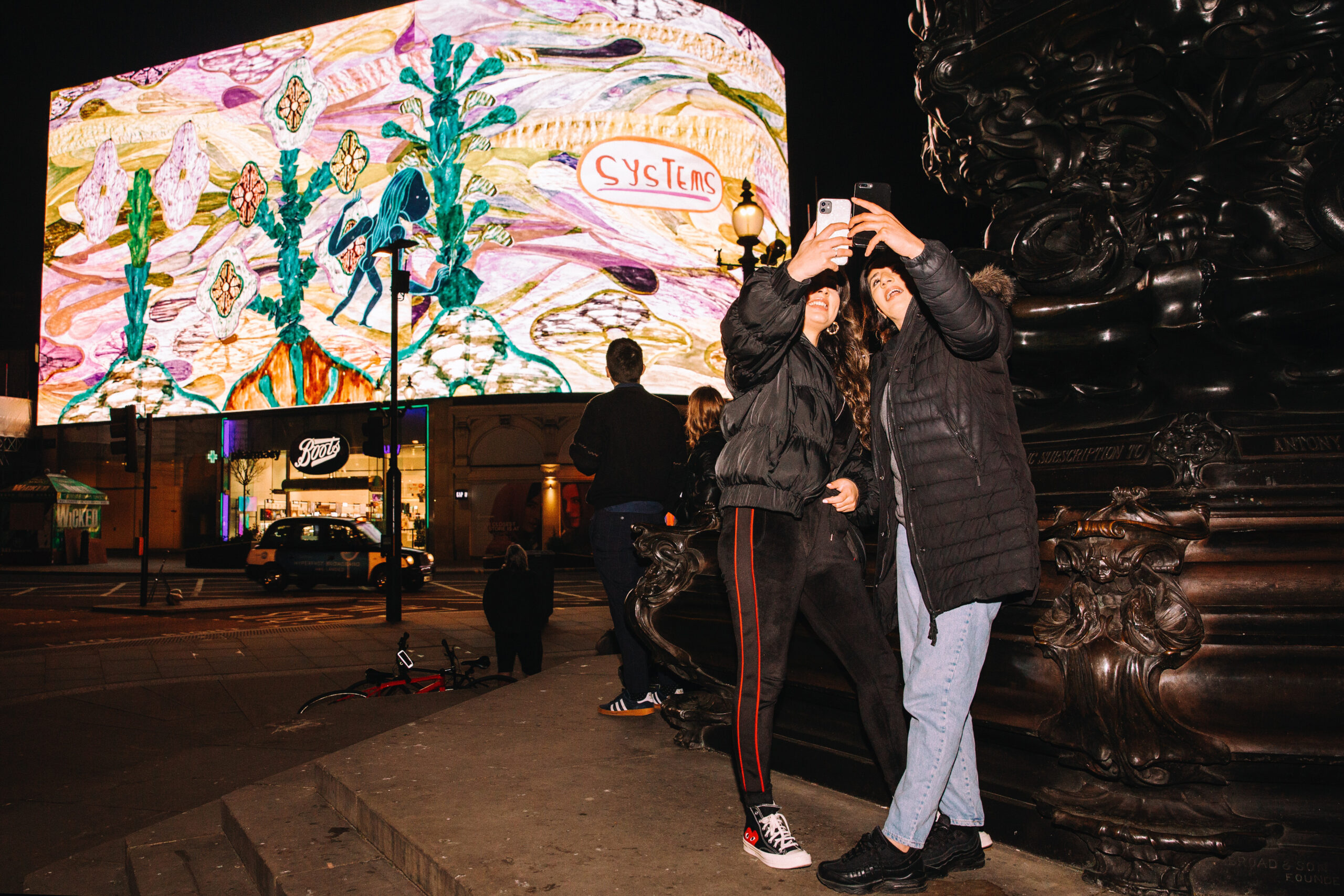
For CIRCA’s March 2021 commission, Emma Talbot presents Four Visions for a Hopeful Future, a sequence of animated works unfolding across Piccadilly Lights throughout the month. Appearing at the approach of spring and coinciding with International Women’s Day, the commission occupies a moment suspended between reflection and anticipation. A year after the onset of the COVID-19 pandemic, societies across the world find themselves poised between the collapse of familiar certainties and the possibility of profound transformation. Rather than asking how we return to the world that existed before, Talbot asks what kind of world might emerge next.

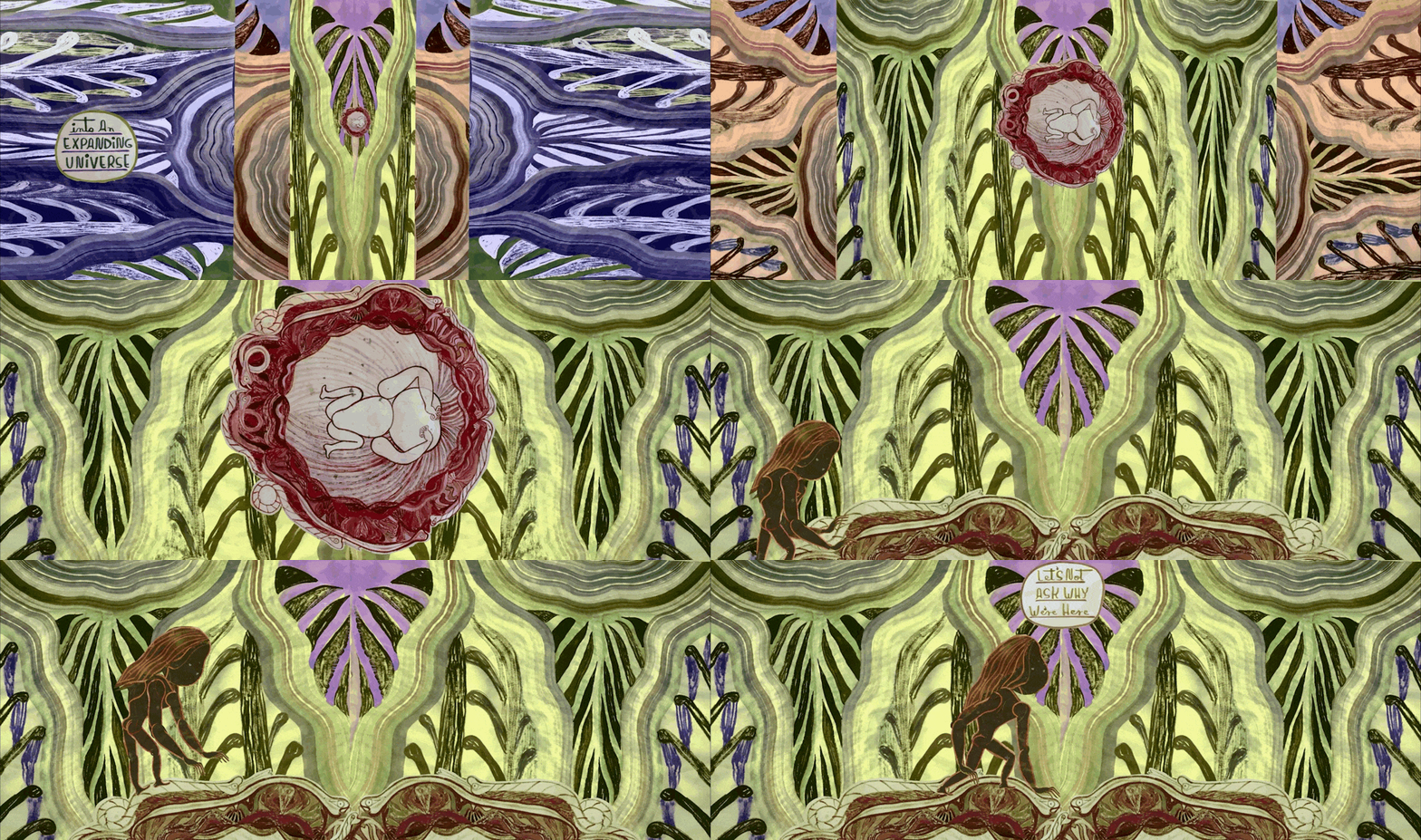
The commission follows a recurring protagonist through four interconnected chapters. Part guide, part witness and part surrogate for the viewer, this faceless figure journeys through landscapes populated by celestial bodies, plants, storms, ruins and imagined futures. Moving between personal reflection and collective speculation, the films operate less as narratives than as visual propositions, asking how different forms of life, community and value might be conceived.

Throughout her practice, Talbot has explored the relationship between individual experience and wider social structures. Combining text, drawing, painting, sculpture and animation, her works transform interior thought into expansive visual worlds. The personal and political are never separated. Questions of gender, labour, ecology, ageing and inequality emerge through intimate reflections that gradually expand into broader considerations of contemporary life. In this sense, Talbot belongs to a lineage of feminist artists and writers who have insisted that private experience is inseparable from public reality.

The intellectual framework underpinning Four Visions for a Hopeful Future emerges from a growing body of thought that understands crisis not only as a moment of danger but also as a moment of possibility. The commission draws particular inspiration from Arundhati Roy’s description of the pandemic as “a portal, a gateway between one world and the next.” For Roy, moments of rupture expose the assumptions upon which societies are built, creating opportunities to imagine alternative futures rather than simply restoring existing systems. Talbot takes this proposition seriously. Across the four animations, the future appears not as a destination but as an act of collective imagination.

This concern resonates throughout the work’s individual chapters. A Year of Dark Shadows reflects upon grief, isolation and endurance, asking what forms of healing become possible after prolonged uncertainty. What Is a City? turns towards the structures of contemporary urban life, questioning systems built around perpetual growth, extraction and inequality. Our Own Creation proposes new ways of imagining the future itself, while Chorus concludes by emphasising the collective nature of transformation, suggesting that no future can be built alone.

Running through each chapter is a challenge to the accelerated logic of contemporary capitalism. Talbot repeatedly contrasts systems driven by endless productivity with alternative rhythms drawn from nature, ecology and seasonal change. Trees grow and shed leaves. Birds migrate. Planets rotate. Human life is re-situated within larger cycles that exceed the demands of efficiency and accumulation. Rather than presenting progress as a linear movement forwards, the work proposes a more reciprocal relationship between people, communities and the environments they inhabit.

The commission’s visual language reinforces this proposition. Talbot’s hand-drawn figures drift through landscapes where boundaries between body and world become fluid. Plants merge with human forms. Rivers become pathways of thought. Constellations mirror emotional states. These transformations recall traditions of mythological storytelling while simultaneously engaging contemporary ecological thinking, where interdependence rather than individuality becomes the fundamental condition of existence.

There is also a significant historical dimension to the work. Talbot draws attention to moments when periods of crisis have been followed by cultural renewal, invoking the ways in which societies have repeatedly reimagined themselves in the aftermath of upheaval. Such references are not offered as historical guarantees but as reminders that transformation has always emerged from periods of uncertainty. The future remains unwritten.

Presented on one of the world’s most visible advertising screens, Four Visions for a Hopeful Future introduces a different set of values into public space. Where advertising promises fulfilment through consumption, Talbot asks audiences to participate in an act of collective imagining. The commission does not offer a blueprint for what comes next. Instead, it insists that the ability to envision alternatives remains one of the most powerful political and creative acts available to us.

At a moment when much of the world stands between what was and what might yet be, Talbot transforms Piccadilly Circus into a portal of its own: a space in which the future can be rehearsed, questioned and imagined before it arrives.


Shop

Loading products...

Films

Michelangelo Pistoletto’s Three Mirrors is presented daily across CIRCA’s global network of public screens. Each evening at 20:26 (local time), the work appears simultaneously across the following locations, entering the flow of the city and inviting a shared moment of reflection. Select a location below to view directions and find your nearest screen on Google Maps.

London, Piccadilly Lights

Experience  Four Visions for a Hopeful Future by Emma Talbot every evening at 20:21 BST/GMT (1-31 March 2021) on the iconic Piccadilly Lights screen.

View screen locations

ESSAY

Ouroboros Time in the Universe of Emma Talbot Written by Louisa Elderton
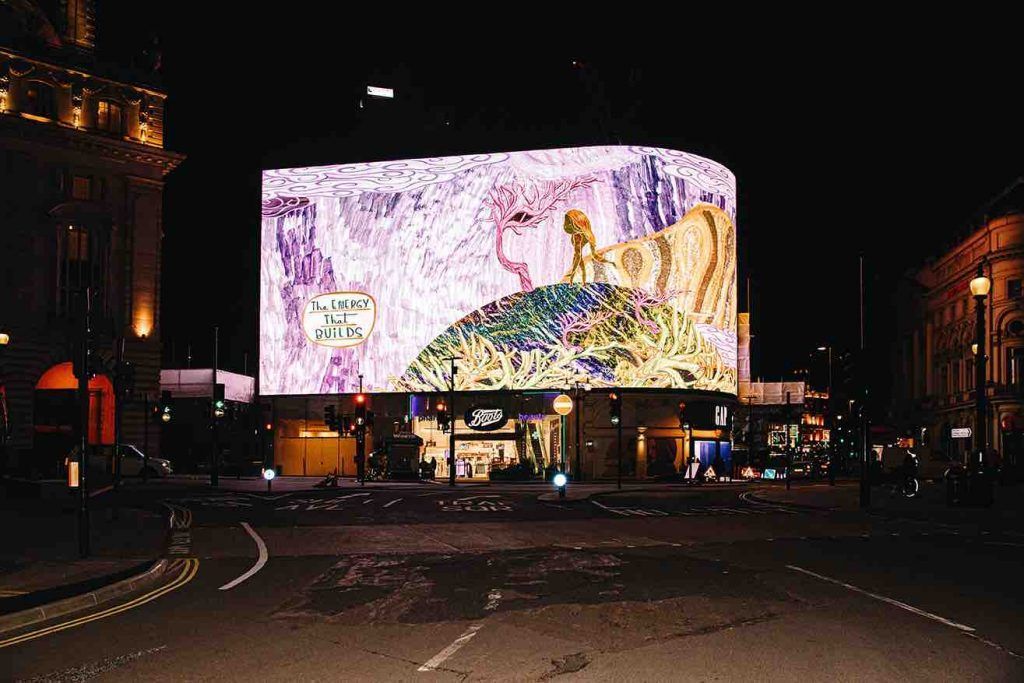
What may your vision for a hopeful future look like? How to explicate the way the world could be? How to harness time; fold it, elongate it, compress it according to the shapes that you want to see? And how may your body move in relation to these shapes, with skin that wants to feel? As depicted by the British artist Emma Talbot’s work, fingertips curl into themselves if there is no one else to touch. Plant tendrils coil as they climb, spiralling, stretching for support. Galaxies assiduously swirl, systems of stars, dust and dark matter that are gravitationally bound and yet celestial. There are infinite such layers that constitute our universe, but what else could our world be? Or rather, how else could it function?

Talbot’s series of four animations for CIRCA, Four Visions For a Hopeful Future (all works 2021), conjures such questions. Of a post-viral world that needs re-birthing. Known for her drawings, paintings and sculptures that combine word and image to narrate the complex nature of human existence, these are Talbot’s first animations, a self-taught skill that she learnt in 2020 during the UK’s first coronavirus lockdown.
Press

Wallpaper*
The Style Mate
Exibart
Fad
The Ducker
Press Release

Biography

Emma Talbot

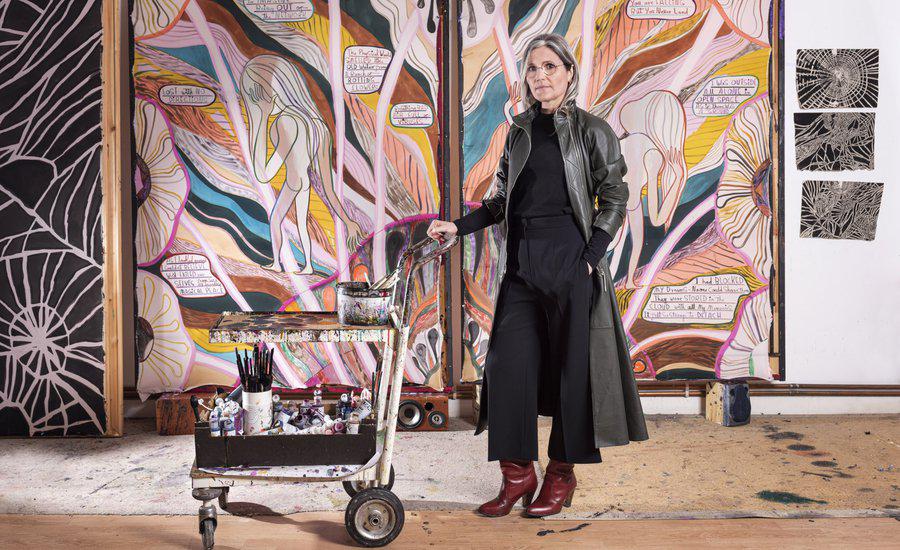
Emma Talbot is one of the most distinctive voices in contemporary British art, creating immersive worlds that combine drawing, painting, sculpture, animation and text. Through a deeply personal visual language, her work explores the emotional and psychological dimensions of contemporary life, addressing themes including gender, ageing, environmental collapse, power and the possibility of transformation. Blending autobiography with mythology, philosophy and social commentary, Talbot creates narratives that are both intimate and universal.

Working primarily through hand-drawn imagery and her own writing, Talbot constructs vivid landscapes inhabited by recurring female protagonists who navigate moments of uncertainty, vulnerability and change. Her practice is characterised by a belief in imagination as a tool for survival and renewal, proposing alternative ways of living, caring and relating to one another in an increasingly complex world.

In 2021, Talbot collaborated with CIRCA on Four Visions for a Hopeful Future, a month-long public commission presented on Piccadilly Lights. Coinciding with International Women’s Day, the project transformed Europe’s largest advertising screen into a space for reflection on healing, collective responsibility and societal renewal in the aftermath of the pandemic. Across four animated chapters, Talbot invited audiences to imagine new futures shaped not by endless growth and consumption, but by empathy, sustainability and care. Released alongside the commission, Voices That Call Out extended these ideas into print, offering collectors a fragment of her hopeful vision for a world in transition.

Talbot was awarded the Max Mara Art Prize for Women in 2020, leading to major solo exhibitions at Whitechapel Gallery, London, and Collezione Maramotti, Italy. Her work has also been presented at institutions including Tate St Ives, Dundee Contemporary Arts, Jupiter Artland and Kunstmuseum Bonn. Through a practice that combines visual beauty with urgent social questions, Talbot continues to imagine new possibilities for how we might live together and shape the future.


Subscribe to our newsletter

Subscription successful

An error occurred